
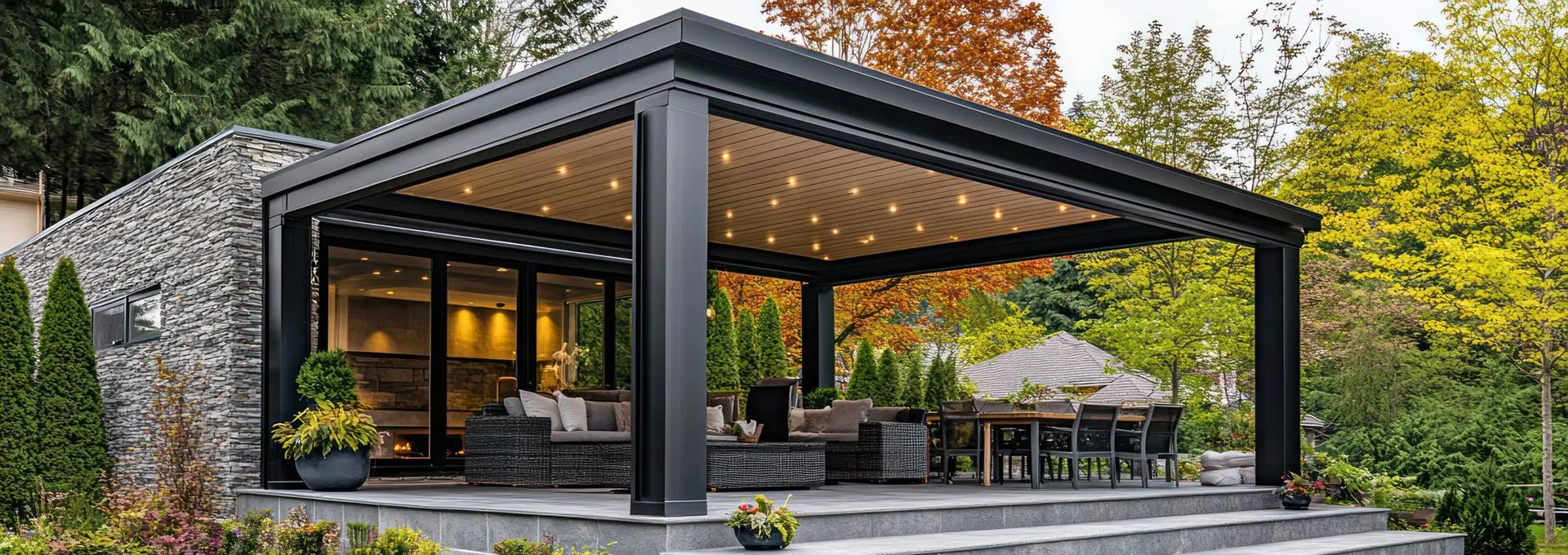
Sinop Pergola and Bioclimatic Pergola
Sinop is the northernmost point of Türkiye, a narrow peninsula with sea on three sides. Fish restaurants in the centre, guest houses along the Gerze and Ayancık coast, garden homes inland — all of them meet the same two conditions: wind that never stops and salt-laden damp.
The climate is mild; it neither freezes like Erzurum nor scorches like Antalya. So the real question here is not temperature but a terrace rendered unusable by wind. In Sinop, what empties a table is almost always the wind.
Why Pergola Systems Are Chosen in Sinop
- Constant wind: The peninsula is open on three sides, and a still day is rare.
- Perceived temperature: Because wind sweeps away the still layer of air on the skin, 20 degrees feels like 15.
- Salt air: Proximity to the sea from every point raises the material class.
- Fishing and tourism: At shoreline businesses, outdoor space is capacity.
Bioclimatic Pergola Systems in Sinop
Where wind is constant, an armed or fabric-covered system spends most of the year retracted — which is to say absent. A louvred aluminium canopy therefore leads in Sinop: its rigidity means it never has to retract and it stays put while the wind blows.
Two calculations still apply. First, the fixings: wind load lands directly on the connection and the solution changes with the ground; a surface fixing will not do here. Second, the span: load rises with width, and an intermediate support or modular bays may be needed.
The canopy alone is not enough either. The real answer in Sinop is the side enclosure: wind arrives horizontally and an overhead cover does not intercept it. Without a zip screen or a glass wind screen the terrace stays empty.
Where Pergolas and Bioclimatic Pergolas Are Used
- Fish restaurant terraces: Sheltered harbour seating that does not close off the view.
- Guest house courtyards: Breakfast areas along the Gerze and Ayancık coast.
- Garden homes: Barbecue and seating corners inland.
- Public buildings and schools: Waiting areas usable on windy days.
- Marinas: Sheltered service and waiting bays.
Complementary Systems We Supply in Sinop
- Zip screens: The province's real product. Zipped fabric locks into the side rail; unlike a conventional blind it neither billows nor leaves its guide.
- Glass wind screens: Break the horizontal flow without closing the view; 120–130 cm usually suffices at seated level.
- Wind sensors: Not an option but a requirement if a fabric or armed system is used.
- Stainless fixing sets: Where the salt load is high, galvanised steel marks within a few seasons.
Managing the wind rather than blocking it
A common mistake in Sinop is enclosing an area on all four sides. A solid barrier stops the wind but creates turbulence behind it: air spills over the top and curls back, and the table is uncomfortable again. The right approach is to identify the prevailing direction and close that elevation, set the panel height against a seated person's shoulder line, and leave the gaps between panels deliberate. The aim is to shelter the person, not to seal the space.
What drives the price
Area and span, system type, structural section, motors and automation, side enclosure. In Sinop, fixing type and ground preparation form a larger item than elsewhere, and the surface finish class is raised as standard because the sea is close from every point.
Why Elit Pergola?
- Wind direction established on site: Which elevation to close is discussed before dimensions.
- Fixings chosen by load calculation: Ground type and panel area assessed together.
- Materials for salt: Stainless fixings and a high-durability finish come as standard.
- Our own installation team: Installation is never subcontracted.
- After-sales: Spare parts support continues for motors, louvres and fabric.
If you have a project in Sinop, contact us for a free site visit.
Frequently Asked Questions
Should I enclose the terrace on all four sides?
No. A solid barrier creates turbulence behind it and the space is uncomfortable again. Identify the prevailing direction, close that elevation, and set the panel height against seated level.
Is a fabric system suitable for Sinop?
Because the wind is constant, it would spend most of the year retracted. If the area must stay open, a louvred aluminium canopy is the better answer; if fabric is preferred, a wind sensor is mandatory.
How high should a wind screen be?
For seated use, 120–130 cm usually suffices — it protects the shoulder line without blocking a standing person's view. For standing use, 150–170 cm is the range.
How does proximity to the sea affect materials?
The surface finish class rises and stainless fixings become essential. Galvanised steel components mark within a few seasons in this province.
Why do the fixings matter so much?
The entire wind load lands on the connection. A system is only as strong as the surface it is bolted to; a surface fixing will fail in the first gale even with a good profile.