
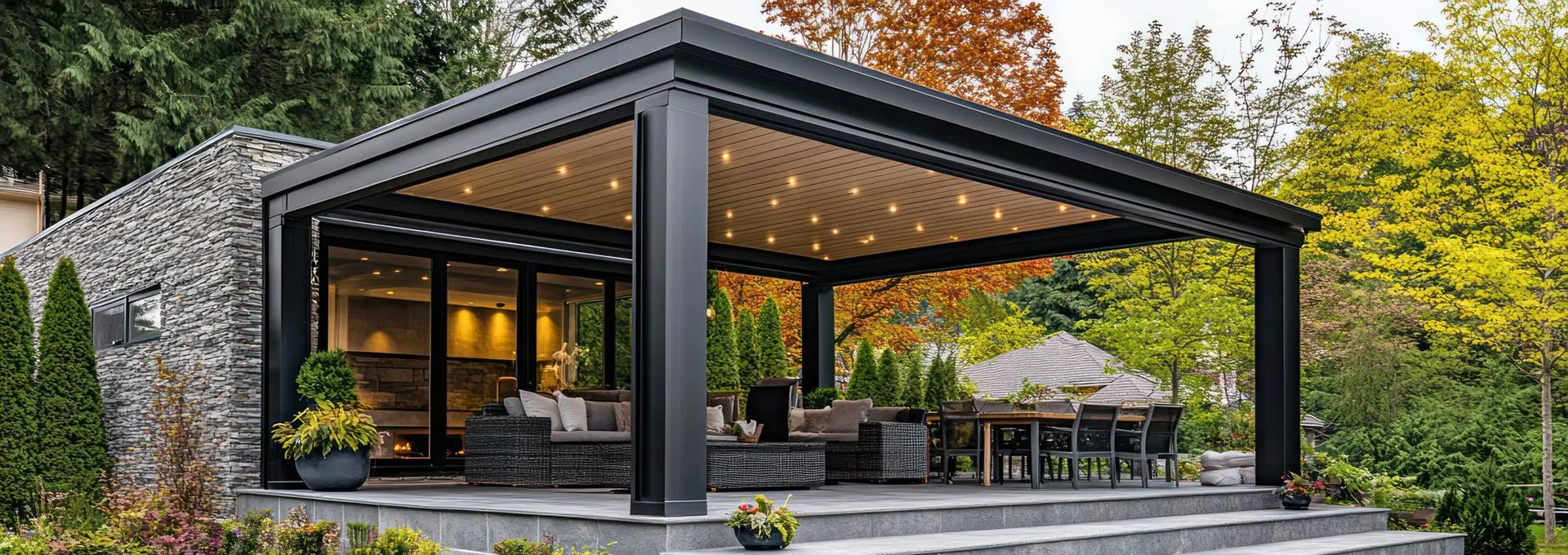
Denizli Pergola and Bioclimatic Pergola
Elit Pergola installs pergola, bioclimatic pergola and shading systems across Denizli — from developments in Merkezefendi and Pamukkale to hotels along the Karahayıt road, social areas at textile and marble plants, and walled gardens in Çivril and Tavas.
Denizli is an industrial city at moderate altitude: summers are hot but drier than on the coast, and winters are distinctly cool. That transitional character means both shade and enclosed use have to be planned in the same project.
Why Pergola Systems Are Chosen in Denizli
- Dry heat: Summer heat carries little humidity, so shade produces fast and noticeable relief here.
- Cool winters: Where winter use is wanted, side enclosure and heating are planned together.
- Tourism: Hotels around Pamukkale and Karahayıt use outdoor space year-round.
- Industry: Textile and marble plants need sheltered social areas and dispatch entrances.
Bioclimatic Pergola Systems in Denizli
Shade works well in dry heat, and having it adjustable through the day carries particular value here. Morning and evening sun arrive at low angles and midday sun is high; the louvre angle manages all three.
In winter the system is asked to work in reverse: opening the louvres lets winter sun in and provides passive heat gain. A fixed overhang cannot do that — it shades in winter too. In provinces with four distinct seasons, that is the real advantage of a moving system.
Where Pergolas and Bioclimatic Pergolas Are Used
- Hotels: Poolsides and breakfast terraces around Karahayıt and Pamukkale.
- Developments and gardens: Shared areas in Merkezefendi and Pamukkale.
- Industrial sites: Canteen entrances, break areas and dispatch doors.
- Cafés and restaurants: Terraces in the city centre.
- Private houses: Garden seating in Çivril and Tavas.
Complementary Systems We Supply in Denizli
- Glazed systems: Double-glazed sliding, folding and guillotine options for heated volumes.
- Zip screens: Cut wind and dust in the shoulder seasons and extend the year.
- Windbreaks: Defining hospitality terraces.
- Double-opening awnings: Coverage with few posts at facilities and car parks.
Circulation at plant entrances
The subject most often skipped on industrial projects is vehicle and pedestrian movement beneath the canopy. Unless post positions are planned with forklift turning circles, lorry approach angles and walking routes, the system will not work properly. That is why we discuss circulation before dimensions at plant surveys.
What drives the price
Area and span, system type, number of posts and profile section, motors and automation, and the choice of side enclosure. Where enclosed winter use is wanted, the glass unit and profile insulation become the most decisive items.
Why Elit Pergola?
- On-site survey: Orientation, circulation and ground assessed on site.
- Transparent quotation: Profile section, glass specification and motor type in writing.
- Four-season planning: Summer shade and winter use in one project.
- Our own installation team: Installation is never subcontracted.
- After-sales: Spare parts support continues for motors, louvres and fabric.
If you have a project in Denizli, contact us for a free site visit.
Frequently Asked Questions
I want to use the space in winter — what is needed?
A side enclosure. A heated volume requires double glazing and thermally broken profiles, plus opposing ventilation openings planned for condensation.
Why a moving system rather than a fixed overhang?
A fixed overhang shades in winter too and blocks passive solar gain. On a moving system, opening the louvres lets winter sun in.
What is done about vehicle access at plant entrances?
Post positions are planned with forklift turning circles, lorry approach angles and pedestrian routes. Where necessary the span is increased and the post count reduced.
Which system suits a hotel poolside?
A bioclimatic pergola is the common choice: it blocks high summer sun, preserves airflow and closes to protect the area in rain. The surface finish class is raised for chlorinated humidity.
How long does installation take?
Once made-to-measure production is complete, a standard terrace usually takes one or two days.