
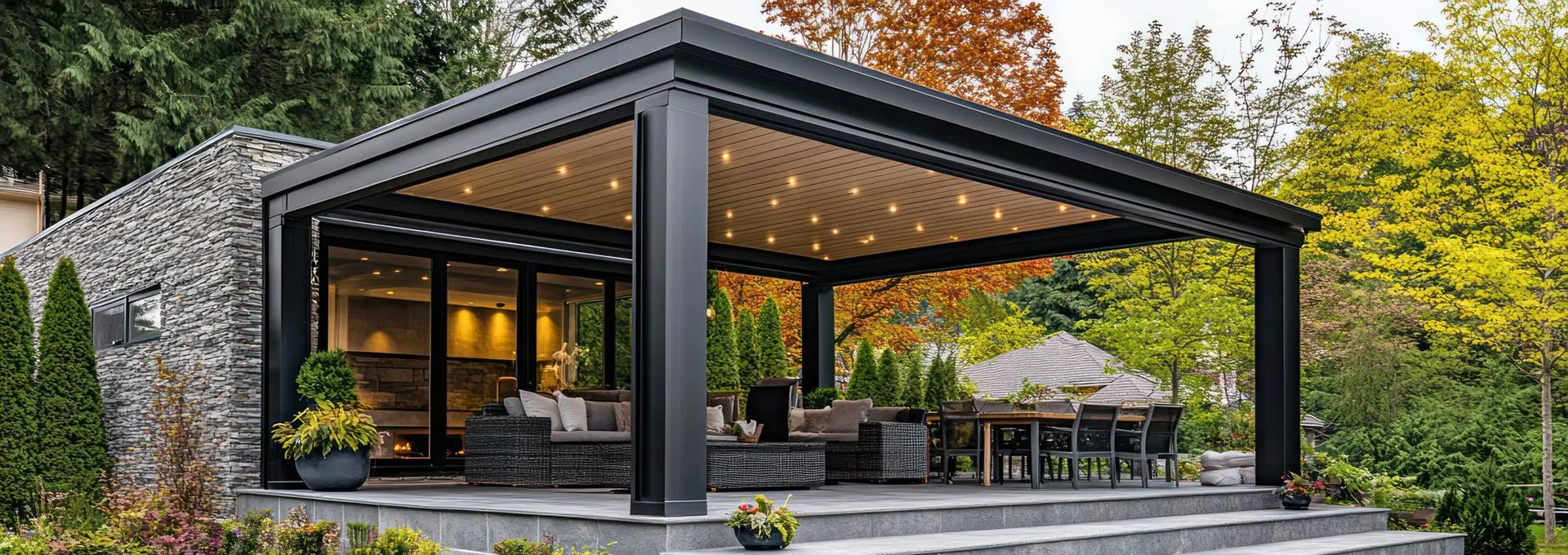
Kırıkkale Pergola and Bioclimatic Pergola
Elit Pergola installs pergola, bioclimatic pergola and shading systems across Kırıkkale — from walled gardens in the city to social areas at industrial plants, detached buildings in Yahşihan and Keskin, and businesses near the university.
Kırıkkale developed largely around industry, and that shapes the character of the work here: alongside residential projects, plant entrances, break areas and dispatch waiting zones make up a significant share.
Why Pergola Systems Are Chosen in Kırıkkale
- Industrial scale: Break areas used at shift change have to be sheltered from rain and sun.
- Continental climate: Dry, hot summers and cold, snowy winters mean planning for both extremes.
- Open-country wind: Nothing stands in the wind's way across plant sites.
- Expectation of durability: Institutional settings favour long-life systems that are simple to maintain.
Bioclimatic Pergola Systems in Kırıkkale
On plant sites what is expected is less appearance than continuity: working every day, every shift. Motor class, cycle endurance and access for maintenance therefore come to the fore. The rigidity of a louvred system means it never has to retract at a wind threshold, allowing uninterrupted use.
In a province that sees snow, the closed-louvre load capacity should be requested in writing. Where the water discharges also matters on plant sites: water directed onto a walking route creates ice in winter.
Where Pergolas and Bioclimatic Pergolas Are Used
- Industrial sites: Canteen entrances, break areas, shift waiting and dispatch zones.
- Private gardens: Seating and barbecue areas in the centre and Yahşihan.
- Institutional: Sheltered routes at the university, schools and public buildings.
- Cafés and restaurants: Terraces in the city centre.
- Developments: Shared social areas and children's play zones.
Complementary Systems We Supply in Kırıkkale
- Zip screens: Cut wind and dust and make break areas usable in winter.
- Glazed systems: Double-glazed options for heated volumes.
- Windbreaks: Interrupting horizontal flow at plants and businesses.
- Double-opening awnings: Coverage with few posts across large car parks and dispatch areas.
Circulation on plant projects
At industrial surveys we discuss circulation before dimensions: forklift turning circles, lorry approach angles, the pedestrian surge at shift change, and escape routes. Unless post positions are planned around these, the system will not work — a dimension that looks right on paper can block a route on site.
What drives the price
Area and span, system type, number of posts and profile section, motors and automation, and the choice of side enclosure. On plant projects, total covered area and post layout lead; on residential ones, the winter enclosure choice.
Why Elit Pergola?
- On-site survey: Circulation, ground and wind direction assessed on site.
- Transparent quotation: Motor class, load capacity and discharge points in writing.
- Institutional experience: We recommend long-life arrangements that are simple to maintain.
- Our own installation team: Installation is never subcontracted.
- After-sales: Spare parts support continues for motors, louvres and fabric.
If you have a project in Kırıkkale, contact us for a free site visit.
Frequently Asked Questions
How are post positions decided on a plant site?
They are planned with forklift turning circles, lorry approach angles, pedestrian flow and escape routes. Where necessary the span is increased and the post count reduced.
Can a break area be used in winter?
It can. Adding zip screens to the canopy stops wind and driven rain; with a heater the area becomes usable through the shift.
Is snow loading a problem in Kırıkkale?
Snowfall occurs, so the closed-position load capacity should be requested in writing for louvred systems.
How is icing prevented on walking routes?
The discharge point must run clear of the walking line and connect to a suitable drain; otherwise meltwater forms a sheet of ice in winter.
How long does installation take?
Once made-to-measure production is complete, a standard terrace usually takes one or two days; at plant scale it depends on the number of areas.