
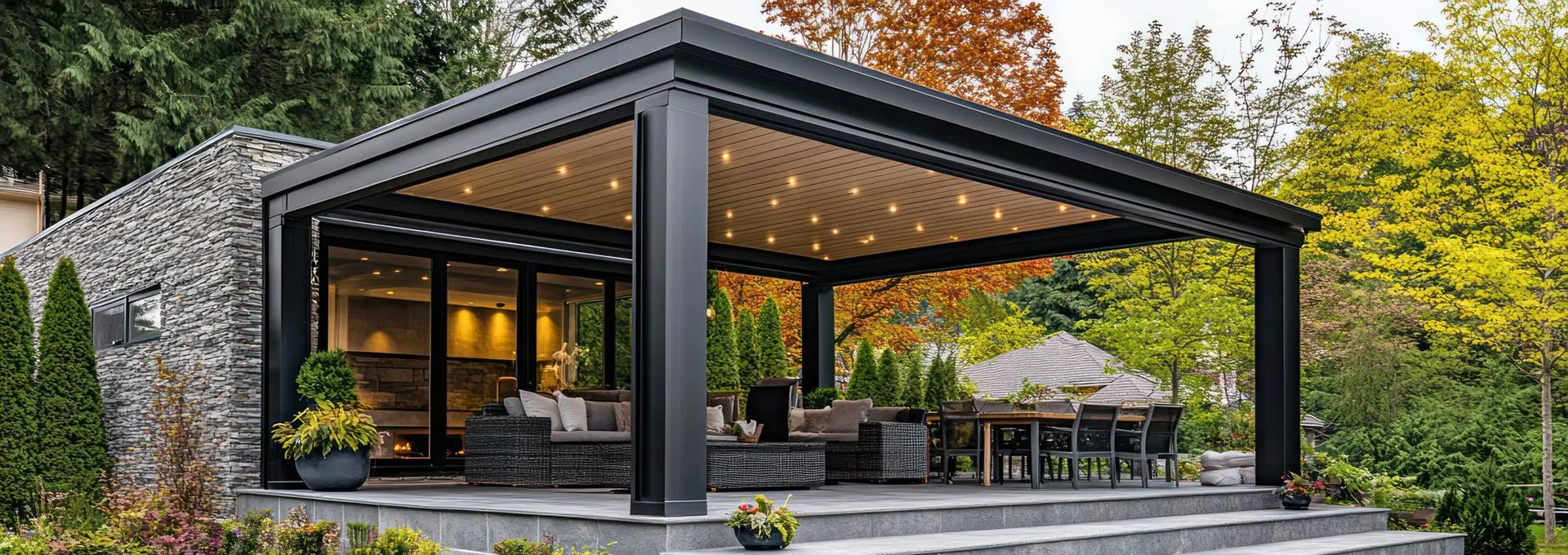
Istanbul Pergola and Bioclimatic Pergola
Elit Pergola installs pergola, bioclimatic pergola and shading systems across Istanbul. We work with a wide range of building types: roof terraces overlooking the Bosphorus, garden developments on the Anatolian side, narrow-fronted businesses in Beyoğlu, and summer houses out towards Şile and Silivri.
In Istanbul, what governs an outdoor investment is as much the space itself as the climate. Square metres are expensive, balconies are narrow, getting materials onto a roof terrace is a job in itself, and almost every installation raises a management decision. This page sets out those local constraints and how we work around them.
Why Pergola Systems Are Chosen in Istanbul
Open space is scarce here, so every square metre counts. An unusable balcony or an empty roof terrace genuinely enlarges a flat once it becomes somewhere you can sit.
Three factors limit that use:
- Wind: Along the Bosphorus and on upper floors, the northerly wind punishes light furniture and fabric canopies. System choice follows directly from it.
- Rain spread across the year: Rainfall in Istanbul is distributed through most of the year, so shading alone will not make a terrace usable in all four seasons.
- Overlooking: In dense fabric, privacy matters as much as shade.
Taken together, the answer is usually to plan the canopy and the side enclosure as one project.
Bioclimatic Pergola Systems in Istanbul
On a bioclimatic pergola the canopy is made of rotating aluminium louvres. Closed, the panels interlock and the surface behaves like a roof; water drains through a concealed gutter in the structural profile and down inside the posts.
Two benefits stand out in Istanbul. The first is that a sudden shower does not end the evening. The second is that leaving the louvres part-open lets warm air escape upwards without cutting the breeze entirely — noticeable on summer nights.
On roof terraces, how the structure connects to the building is decisive. A detail that adds no load to the existing structure, does not damage external insulation and leaves the rainwater arrangement intact is resolved during the site visit.
Where Pergolas and Bioclimatic Pergolas Are Used
- Roof terraces: Shade without losing the city view, with side enclosure against wind.
- Balconies: Post-free solutions where there is nowhere to stand a post.
- Garden developments: Poolside and shared social areas planned as one scheme.
- Cafés and restaurants: Pavement and courtyard layouts that keep evening service running.
- Hotels and boutique stays: Breakfast terraces that work regardless of the weather.
Complementary Systems We Supply in Istanbul
Where a canopy alone is not enough:
- Zip screens: The fabric locks into side rails and does not flap in wind — the most popular enclosure on upper floors.
- Glazed systems: Sliding, folding and guillotine options for a volume that can be heated in winter.
- Windbreaks: Toughened glass panels that also define the space on a hospitality terrace.
- Folding-arm awnings: For balconies with no room for posts.
Consents and building management
In apartment blocks and developments, work that changes the appearance of an elevation brings the owners' assembly into play, and a decision is mandatory in common areas. Commercial installations on a pavement need a separate licence from the council. In conservation areas and places with urban design codes, colour, materials and height may be conditioned. We identify which documents apply during the site visit and prepare a dimensioned sketch to attach to the decision.
What drives the price
We publish no figures; they date quickly and change with every project. Instead we explain the items: area and span, system type, number of posts and profile section, motors and automation, and the choice of side enclosure. The sixth item, particular to Istanbul, is access: a system going to the eighth floor of a building without a lift does not carry the same installation cost as one at garden level.
Why Elit Pergola?
We manufacture in Adana and work on a project basis in Istanbul. Survey, production, installation and after-sales support all stay with our own team.
- On-site survey: Dimensions, falls, connection details and access are established on site.
- Transparent quotation: Profile section, wall thickness, motor type and drainage arrangement are all set out in writing.
- High-rise experience: Wind loads and fixings are calculated for the actual floor level.
- Our own installation team: Installation is never subcontracted.
- After-sales: Spare parts support continues for motors, louvres and fabric.
If you have a project in Istanbul, send dimensions and photographs; after an initial assessment we arrange a site visit.
Frequently Asked Questions
Can I install a pergola on my apartment balcony in Istanbul?
The regulation usually allows it, but work that changes the appearance of the elevation brings the owners' assembly into play. Obtaining the decision with a dimensioned sketch and colour reference attached protects you against later objections.
Is wind a problem on upper floors?
Wind speed rises with height, so fixings and profile sections are chosen for the floor level. On fabric systems a wind sensor is effectively a requirement, retracting the canopy automatically once a threshold is passed.
How do materials reach a roof terrace?
It depends on access. Where a lift is suitable, components go up in sections; otherwise a facade hoist or rope lift is planned. This item is established at survey and listed separately in the quotation.
Can I install on the pavement outside my café?
A pavement is public land and needs a separate licence from the council, independently of the product. In conservation areas, colour and materials may also be conditioned.
How long does installation take?
Once made-to-measure production is complete, a standard terrace usually takes one or two days. Glazed, wide-span and difficult-access projects take longer.