
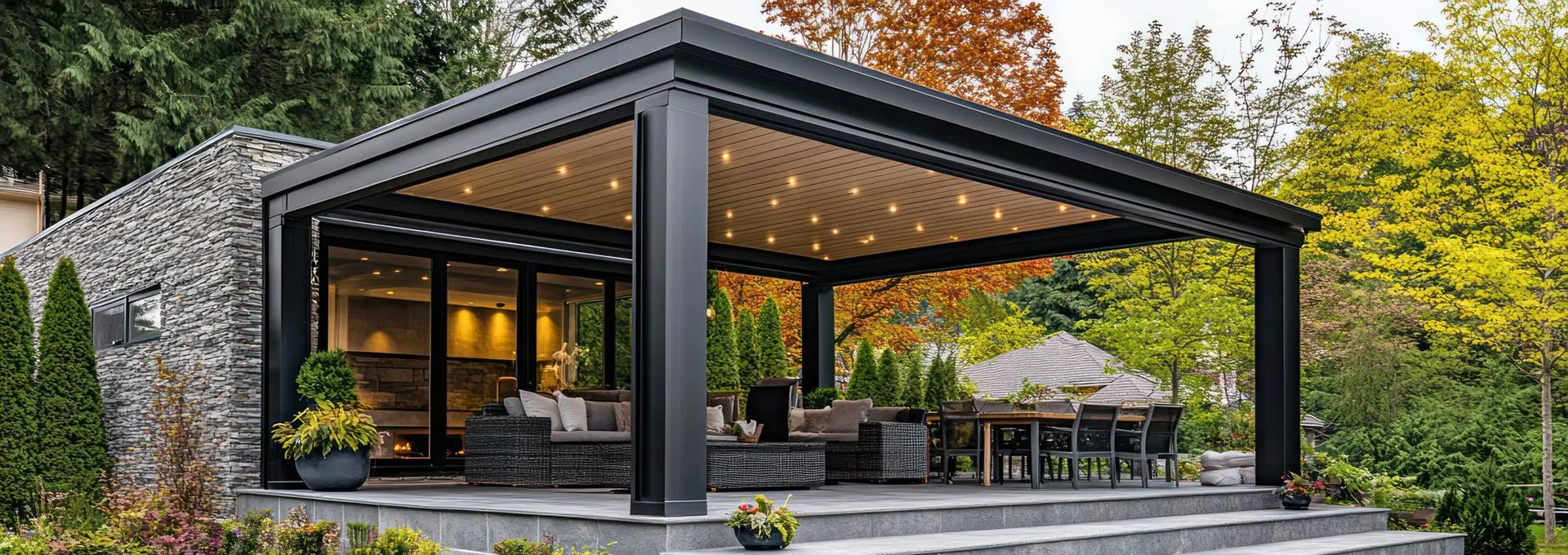
Ordu Pergola and Bioclimatic Pergola
What people want from a system in Ordu differs from most provinces, and sounds contradictory at first: let the sun through and keep the rain out. The reason is hazelnuts. A drying yard after harvest needs sun — but on the Black Sea, rain arrives within the hour and soaks the crop.
Beyond that, Ordu is built on slopes falling straight to the sea. Houses below Boztepe, businesses along the shore, hazelnut groves inland — on all of them, gradient is discussed before dimensions.
Why Pergola Systems Are Chosen in Ordu
- Hazelnut drying: Areas that need sun but must close in rain — the clearest case for a moving canopy.
- Frequent rain: Rainfall is not confined to a season, and a canopy that closes markedly increases usable days.
- Gradient: On hillside sites post levels are unequal, and the structure follows.
- Humidity: Air stagnating under a solid cover makes a space oppressive.
Bioclimatic Pergola Systems in Ordu
A drying yard is the clearest illustration of what a louvred system does. Fully open, the sun reaches the crop directly and it dries; when cloud arrives, one button closes the canopy and the surface behaves like a roof. Fabric cannot do this — it is either open or closed, and open it offers no protection at all.
Two details matter in this use. First, a rain sensor, so nobody has to watch the sky. Second, drainage: when the canopy closes, the water running off it must discharge outside the drying yard, not into it — otherwise you wet the very crop you are protecting.
On the residential and hospitality side, gradient decides. On a slope each post sits at a different level; the difference is absorbed either by posts of varying length or by a levelling beam. The ground decides which, at survey.
Where Pergolas and Bioclimatic Pergolas Are Used
- Hazelnut drying and grading yards: A canopy that admits sun and closes in rain.
- Hillside terraces: Seating open to the view below Boztepe.
- Shoreline businesses: Rain-independent service.
- Garden homes: Barbecue and seating corners around Fatsa and Ünye.
- Public buildings: A dry walking line at stepped entrances.
Complementary Systems We Supply in Ordu
- Rain sensors: Close the canopy over a drying yard automatically — the most useful accessory in this province.
- Waterproof zip screens: Stop driven rain; mesh offers no protection here.
- Levelling-beam structures: Equalise post levels on sloping ground.
- Edge-discharge drainage: Taking water clear of the protected area when the canopy closes.
An area that wants sun and refuses rain
A hazelnut drying yard is one of the rare places where no fixed solution works. A solid roof will not dry the crop; an open yard soaks it in rain. What is needed is a canopy that can change position within seconds — and preferably one that does so itself. A louvred canopy with a rain sensor does exactly that: it closes when cloud arrives and opens when it passes. In Ordu, the return on the system is measured directly in the crop.
What drives the price
Area and span, system type, structural section, motors and automation, side enclosure. In Ordu, the level solution and, on drying projects, sensor and drainage arrangements appear as separate lines.
Why Elit Pergola?
- Levels measured on site: Post levels taken in place, not from a sketch.
- Automation for drying: Rain sensor and closing time selected for the project.
- Discharge direction planned: Water taken clear of the protected area.
- Our own installation team: Installation is never subcontracted.
- After-sales: Spare parts support continues for motors, louvres and fabric.
If you have a project in Ordu, contact us for a free site visit.
Frequently Asked Questions
A drying yard needs both sun and protection — is that possible?
It is. Fully open, the louvres admit sun directly; a rain sensor closes the canopy when cloud arrives and the surface behaves like a roof. Fabric covers cannot do both.
Where does the water go when the canopy closes?
It must discharge outside the drying yard. Water dripping in at the edge wets the crop you are protecting, so the discharge direction is planned at survey.
Can a system be built on sloping ground?
It can. Either posts are made to different lengths or a levelling beam fixes the top level; the ground decides which.
Is a rain sensor essential?
In a drying yard, effectively yes — nobody should have to watch the sky and press a button. For domestic use it is a convenience rather than a requirement.
Is shade enough in humid air?
Not on its own. Humid air is trapped under a solid cover; being able to turn the louvre angle releases it upwards.