
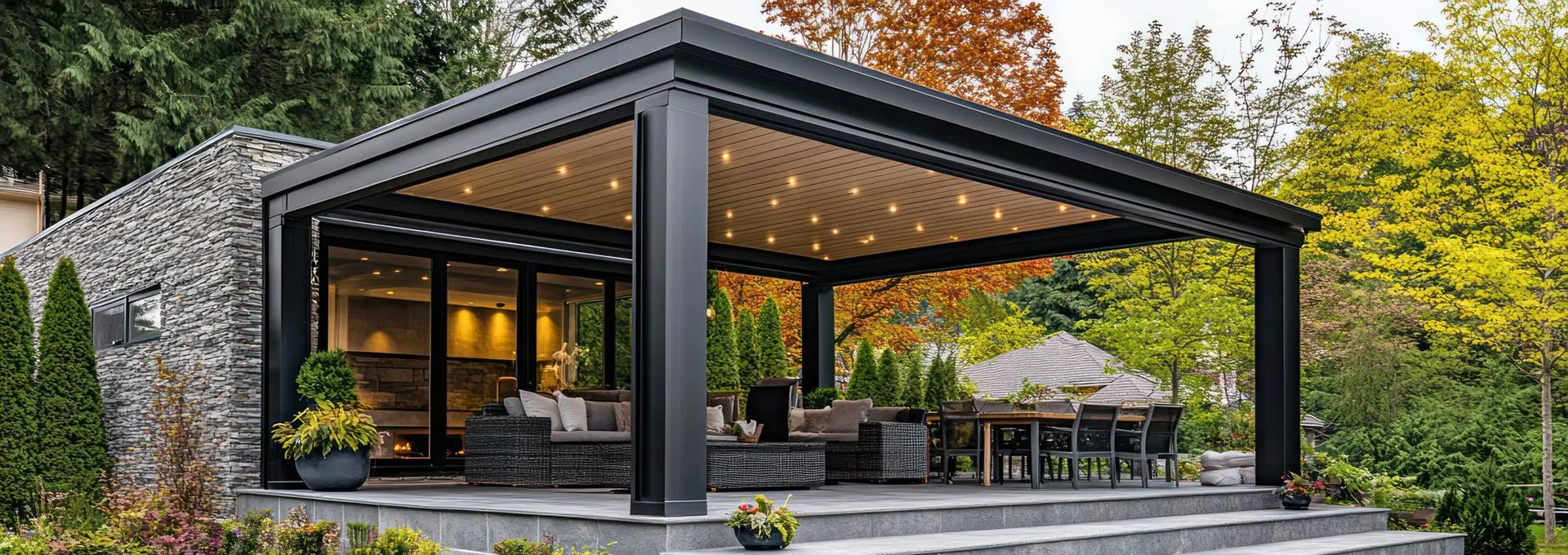
Siirt Pergola and Bioclimatic Pergola
Summers in Siirt are long, dry and fierce. Unshaded space is entirely unusable at midday, so shading here is not a comfort choice but the condition for having outdoor space at all.
The second half of the work is agriculture. Grading, drying and holding areas for pistachios and other crops have to shelter both the crew and the produce. That means a different scale and a different priority from residential projects.
Why Pergola Systems Are Chosen in Siirt
- Dry, long summers: Shade is the precondition for usable outdoor space.
- Pistachio processing: In grading and holding areas, direct sun causes quality loss.
- Valley and altitude differences: Temperatures differ markedly between the Botan valley and higher ground.
- Dust: On dry ground, wind-borne dust makes side enclosure necessary.
Bioclimatic Pergola Systems in Siirt
For shade to work in dry heat, the air has to move. Warm air builds up under a solid fabric cover; air filtering between the louvres releases it upwards. That difference amounts to several degrees of perceived temperature under the same shade.
The second subject is the shade angle changing through the day. Sun from the east in the morning, overhead at midday and from the west in late afternoon arrives at different angles; a fixed canopy answers only one. Being able to turn the louvre angle keeps the same area usable all day.
On agricultural sites the brief is plain: wide spans, few posts, a surface that wipes down. A layout that lets forklifts and trailers turn cleanly keeps produce out of direct sun while it waits.
Where Pergolas and Bioclimatic Pergolas Are Used
- Pistachio processing plants: Grading, pre-drying holding and loading areas.
- Garden homes: Shaded seating and barbecue areas in the centre and Kurtalan.
- Cafés and restaurants: Terraces built for daytime use in the city.
- Schools and public buildings: Shaded waiting areas in the grounds.
- Hospitality: Hotel and guest house terraces.
Complementary Systems We Supply in Siirt
- Mesh zip screens: Intercept low morning and evening sun while letting air through.
- Breathable acrylic fabric: Where fabric is preferred; it does not trap warm air beneath.
- Glass wind screens: Intercept dust carried on the wind across dry ground.
- Centre-opening awnings: To cover a grading yard from two uprights.
Shade for the crop, ventilation for the crew
Two different needs are met at once at pistachio facilities. For the crop, what matters is keeping direct sun off: in-shell produce heats quickly at the surface while it waits. For the crew, what matters is air moving beneath the cover: working under a solid canopy is not much more comfortable than working without one. A louvred system delivers both — fixed shade with adjustable airflow.
What drives the price
Area and span, system type, structural section, motors and automation, side enclosure. Here shade control and fabric type lead, and on agricultural projects, total covered area and vehicle turning circles.
Why Elit Pergola?
- Shade and ventilation together: In dry heat the two are inseparable.
- Layout by circulation: On farm sites, post positions follow vehicle movement.
- Transparent quotation: Sections, fabric type and weight stated in writing.
- Our own installation team: Installation is never subcontracted.
- After-sales: Spare parts support continues for motors, louvres and fabric.
If you have a project in Siirt, contact us for a free site visit.
Frequently Asked Questions
Is shade enough in dry heat?
Not on its own. Warm air builds up under a solid cover; louvre gaps or a breathable acrylic let it through and the coolness becomes noticeable.
What do you suggest for a pistachio grading area?
A wide-span cover with few posts. In-shell produce left in direct sun heats quickly at the surface, and the layout must not restrict forklift movement.
The sun angle changes through the day — what helps?
Being able to turn the louvre angle. A fixed canopy answers one hour; an adjustable system keeps the area usable all day.
What can be done about dust?
A side enclosure is the most effective answer. A zip screen or glass wind screen interrupts horizontal flow and reduces the dust it carries.
Is enclosed winter use necessary?
Not on most projects; winters on the plain are relatively mild. If a heated volume is wanted, glazing and ventilation are planned together.