
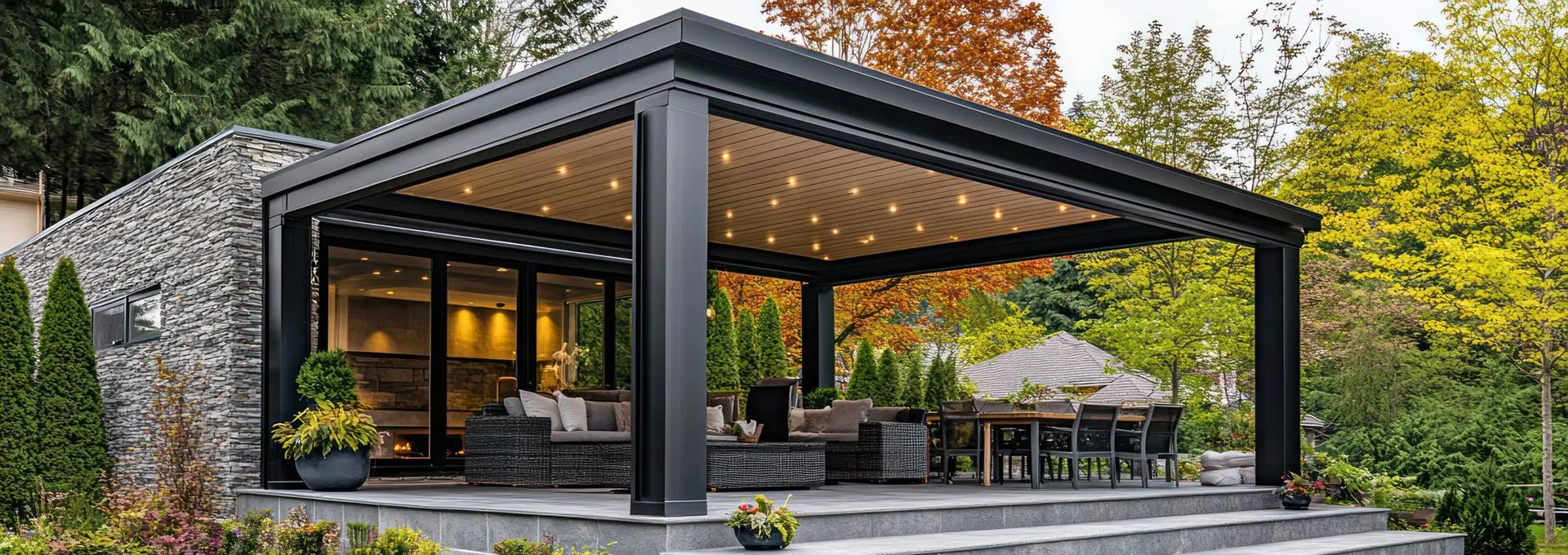
Hatay Pergola and Bioclimatic Pergola
Elit Pergola installs pergola, bioclimatic pergola and shading systems across Hatay. We work throughout the province, principally in Antakya, Defne, İskenderun, Arsuz and Samandağ.
Hatay is a province where sea and mountain meet over a very short distance. The Amanos range runs parallel to the coast, so two distinct microclimates exist within the same province. The coastal strip is humid and mild; inland areas are drier and hotter.
That variety rules out a single standard answer. A restaurant terrace on the İskenderun seafront and a courtyard in Antakya call for different configurations of the same system.
Why Pergola Systems Are Chosen in Hatay
In Hatay the outdoor area sits at the centre of the food culture. Breakfast halls, künefe shops, fish restaurants and cafés carry a large part of their capacity outside. Keeping that area open all year is a direct revenue matter for the business.
On the residential side, the rebuilding process is decisive. In new housing, terraces, balconies and gardens are planned from the outset, and shading is considered part of the project.
The conditions that shape outdoor use here:
- Coastal wind: It strengthens noticeably across the Gulf of İskenderun in the afternoon.
- High humidity: On the coast shade alone is not enough; airflow is needed too.
- Long season: Outdoor areas are usable from late March to November.
- Winter rain: Rainfall rises between December and February, so terraces need to be closable.
Where we install most often in Hatay:
- Restaurant, breakfast hall and café terraces
- Open sections of hotels and boutique guesthouses
- Terraces and gardens of newly built housing
- Seafront businesses in İskenderun and Arsuz
- Entrances to administrative buildings on industrial sites
Bioclimatic Pergola Systems in Hatay
A bioclimatic pergola is a roof system of movable aluminium louvres. A motor rotates them, and one structure does three jobs at once: shading, ventilation and rain protection.
On Hatay’s humid coast the ability to set the louvre angle in stages is a decisive advantage. A fully closed roof leaves the space beneath it hot and still in humid weather. Opening the louvres slightly lets warm air rise.
For hospitality terraces we highlight three points:
- Capacity survives the rain: When the louvres close, service is not interrupted.
- Wind sensor: As the gulf wind builds, the system moves to a safe position.
- Concealed drainage: Water runs from the gutter down inside the post; nothing drips on a guest.
Near the shore, material choice is a subject in its own right. Aluminium profiles and stainless fixings give long service life in salt-laden air.
Where Pergolas and Bioclimatic Pergolas Are Used
System choice depends on who uses the area and at what hours. A business and a home need different configurations even at the same size.
Patterns we meet often in Hatay:
- Seafront restaurant: Wind loading is high. Structural sizing and side enclosure are planned together.
- City courtyard: Airflow is weak in spaces walled on four sides, so a louvred system is preferred.
- Residential terrace: Where there is a view, side enclosure is specified in glass so the outlook is not lost.
- Hotel breakfast area: Morning sun and midday shade are considered together.
During the survey we record which way the terrace faces and where the wind comes from. Which elevation gets the side enclosure follows from that.
Complementary Systems We Offer in Hatay
In a coastal province the side enclosure matters as much as the roof. Wind and driving rain can make even a covered area unusable.
What we install alongside a pergola most often here:
- Zip screens: Guided on both edges, they stay put in wind — the first choice for seafront businesses.
- Guillotine glass: Encloses the terrace in winter and opens fully in season.
- Sliding glass: Easy operation across wide openings.
- Windbreaks: They protect seating on exposed stretches of coast.
- Glass and screens combined: Glass below with screens above keeps the view while cutting the wind.
We install all of these with one team. Waterproofing at the junction between pergola and glass system is where problems appear most often when separate contractors are involved.
What Determines Pergola Prices in Hatay
Knowing what drives the price makes the conversation easier before you ask for one. We do not quote figures here; figures date, and every project differs. Instead we explain which items appear in a quote.
Items common to every project
- Area size: The width and depth of the surface to be covered come first.
- System type: A fixed pergola, a bioclimatic pergola and an awning sit in different cost groups.
- Number of posts: Wider spans need larger sections, so removing a post can raise the cost.
- Motor and automation: Controls, sensors and lighting are separate items.
- Side enclosure: Glass, zip screens or windbreaks change the price markedly.
Material grade and installation schedule
In coastal districts the profile and fixing grade step up. For businesses, scheduling installation outside service hours also calls for separate planning.
The quote we prepare after the survey lists these items one by one. That way you can see what each choice is worth and steer the budget yourself.
Why Elit Pergola
From our Adana base we serve the whole of Hatay. Survey, manufacture, installation and after-sales support stay with our own team.
- On-site survey: Dimensions, wind direction and ground conditions are established on site.
- Clear quote: Every item affecting the price is written down.
- Coastal-grade materials: Profiles and fixings are chosen with salt air in mind.
- Working around your trading hours: Installation can be scheduled outside service times.
- After-sales: Spare parts support continues for motors, louvres and fabrics.
You can request a free survey for your project in Hatay. After measuring we explain the suitable system and the items that determine the price.
Frequently Asked Questions
Is wind a problem on the İskenderun seafront?
Not when the system is properly sized. Structural sections and anchoring are chosen for the local wind load, and on bioclimatic systems a wind sensor moves the louvres to a safe position.
Can I use a restaurant terrace in winter too?
You can. With a bioclimatic pergola and guillotine glass or zip screens together, the terrace becomes an enclosed space.
What determines pergola prices in Hatay?
Area size, system type, number of posts, motorisation and your choice of side enclosure. On projects near the shore the material grade also plays a part.
Can a pergola be added to a newly built block later?
It can. For wall-mounted systems we check the suitability of the structure during the survey. Where necessary we install a free-standing version on its own posts.
How many days will installation close my business?
Usually none. A standard terrace takes one or two days and we can schedule the work outside service hours. Projects with glass systems take longer, and we share the programme up front.
Will the support posts disrupt my table layout?
That is exactly why we ask for your seating plan before measuring. We position the posts clear of circulation routes and table positions. Where necessary we increase the span and reduce the number of posts.
Do you cover Antakya, İskenderun and Arsuz?
We do. We survey and install across every district of Hatay. In coastal districts we assess the material grade separately for salt air.