
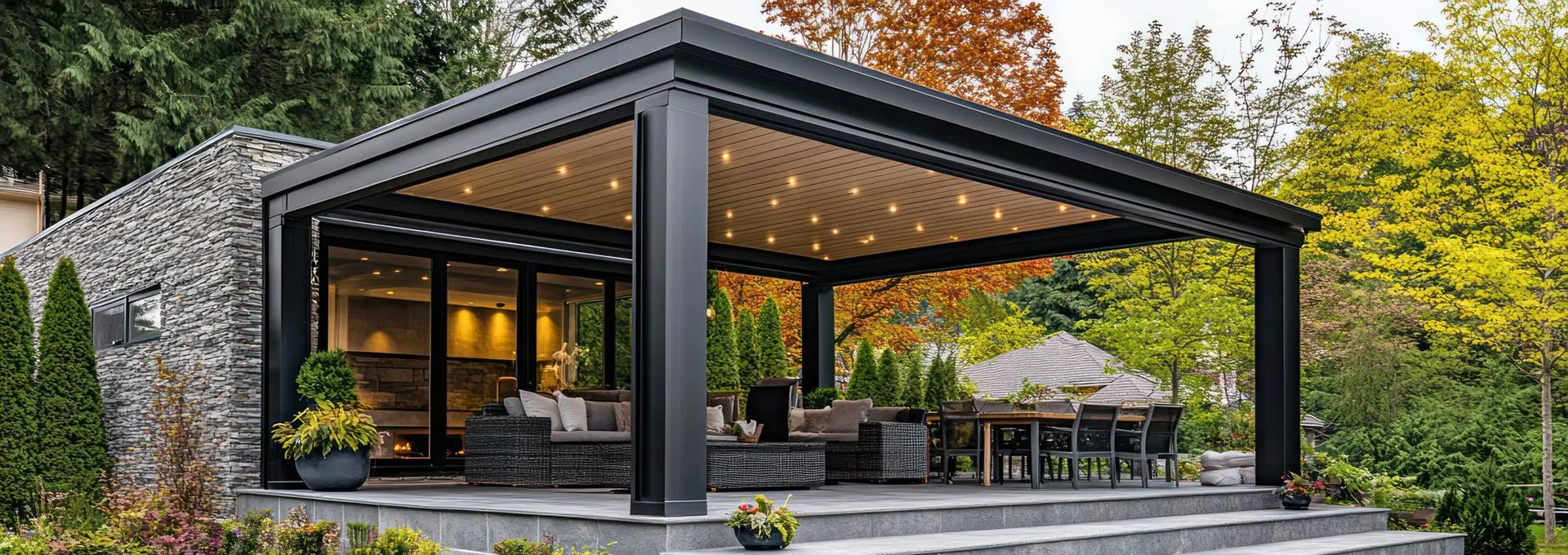
Artvin Pergola and Bioclimatic Pergola
What decides a project in Artvin is not the product but how it gets there. We work in one of the steepest provinces in Türkiye: deep valleys, narrow winding roads, and many settlements around reservoir lakes.
Add some of the heaviest rainfall on the Black Sea coast. Both a hard-to-transport product and a wet climate have to be solved at once, so here we plan the logistics before the production.
Why Pergola Systems Are Chosen in Artvin
- Rainfall: Rain runs through the year and falls hard; a canopy that closes makes outdoor space usable.
- Steep ground: Level ground is rare and post levels are almost never equal.
- Plateau and nature tourism: At guest houses along the Kaçkar range, outdoor space earns directly.
- Reservoir settlements: Around the lakes, humidity and wind act together.
Bioclimatic Pergola Systems in Artvin
Here whether a system can be produced modularly can matter more than its technical specification. If a long profile cannot travel a narrow, winding road, that system cannot be installed at that address. So on Artvin projects we make components to transportable lengths and plan the joints to be completed on site.
The second subject is gradient. On steep ground every post sits at a different level, sometimes a metre apart. Either posts are made to different lengths or a levelling beam fixes the top level. Measuring from a sketch is all but impossible here — levels have to be taken in place.
The third is drainage. With rainfall this heavy the gutter section is enlarged, and on sloping ground where the water discharges is a decision of its own. Released downhill, it scours the ground within a few storms.
Where Pergolas and Bioclimatic Pergolas Are Used
- Guest houses and bungalows: Terraces and entrance canopies along the Kaçkar and Borçka roads.
- Hillside terraces: Seating open to the valley view.
- Lakeside businesses: Café and restaurant terraces around the reservoirs.
- Garden homes: Sheltered seating corners around Hopa and Arhavi.
- Public buildings: A dry walking line at stepped entrances.
Complementary Systems We Supply in Artvin
- Modular production: Components in transportable lengths, with joints completed on site.
- Levelling-beam structures: Equalising post levels on steep ground.
- Large-section gutters: So drainage keeps up with heavy rain.
- Waterproof zip screens: Cutting valley wind and driven rain.
Logistics as part of the quotation
In most provinces, delivery is a single line. Not in Artvin. Getting a system to site means planning component length, vehicle type, road width and, if necessary, how the last hundred metres will be carried. We note this at survey, alongside the dimensions; saying afterwards that a profile will not travel that road means taking a finished system back. So access sits as its own written item in an Artvin quotation.
What drives the price
Area and span, system type, structural section, motors and automation, side enclosure. Two more items join here: access and transport, and the level solution.
Why Elit Pergola?
- Logistics planned first: Component length set by the road.
- Levels taken in place: Sketches are not trusted on steep ground.
- Drainage sized to rainfall: Gutter section and discharge direction stated in writing.
- Our own installation team: Installation is never subcontracted.
- After-sales: Spare parts support continues for motors, louvres and fabric.
If you have a project in Artvin, contact us for a free site visit.
Frequently Asked Questions
Can long profiles travel a narrow, winding road?
Usually not at standard length. We therefore produce components in transportable lengths and plan the joints to be completed on site. Access is a separate item in the quotation.
Can a system be built on very steep ground?
It can. Either posts are made to different lengths or a levelling beam fixes the top level; levels are always taken in place.
Where should water discharge on a slope?
Never freely. Water released downhill scours the ground within a few storms; drainage must connect to a suitable run or drain.
Is a standard gutter enough in heavy rain?
Often not. The section is enlarged and, where needed, the number of outlets increased — a small but critical item in the quotation.
How long does installation take?
Once production is complete, a standard installation takes one or two days; at difficult addresses, extra days are planned for transport.