
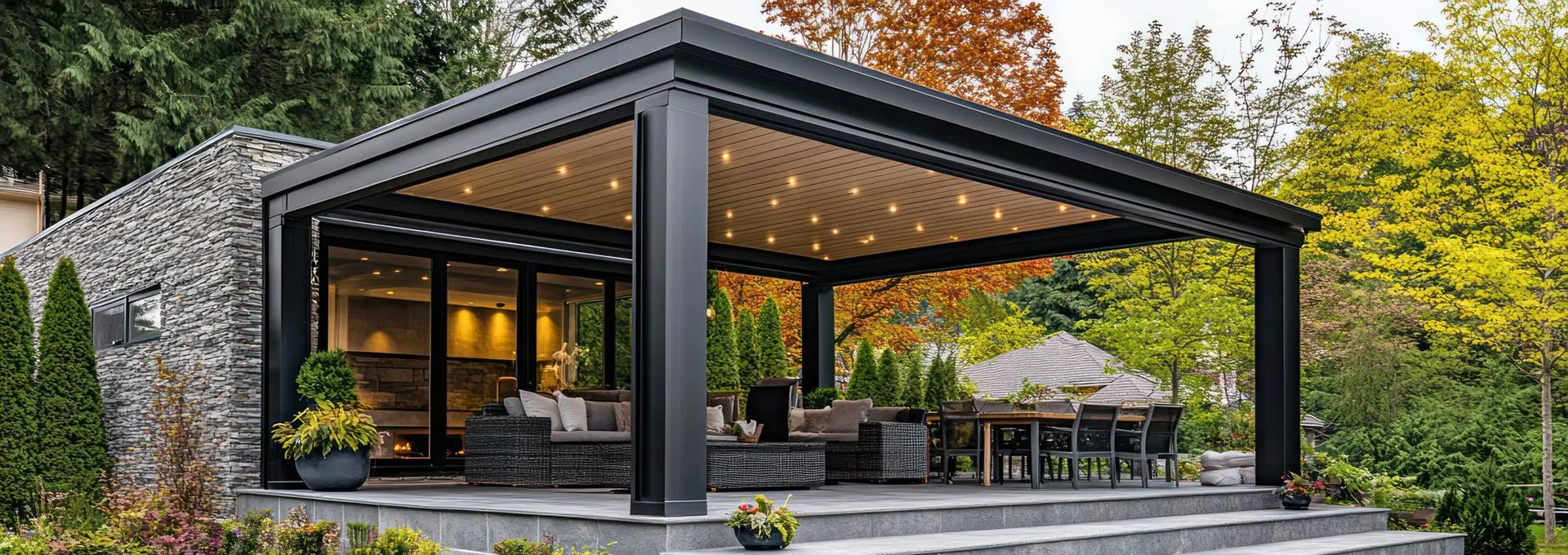
Muş Pergola and Bioclimatic Pergola
On the Muş plain the real problem with snow is not how much falls but where the wind piles it. On broad, flat ground snow does not settle evenly; it drifts and banks against the first obstacle it meets. Metres can build up overnight on the leeward side of a structure.
That is design data for an outdoor system. Where the system goes, which elevation ends up leeward, and where the snow will bank are subjects to settle before dimensions.
Why Pergola Systems Are Chosen in Muş
- Drifting snow: A snow bank creates a far heavier local load than evenly distributed snow.
- Open-country wind: Nothing stands in the wind's way, and the fixing calculation follows.
- Livestock scale: Feed, equipment and milk collection areas need cover.
- A short summer: The outdoor season is brief and must be used well.
Bioclimatic Pergola Systems in Muş
Evenly falling snow spreads across the surface, and the structural calculation follows from that. Drifting snow does not: it banks along one edge and creates a local concentration of load there. So in Muş we size the structure not to the average load but to the drift zone.
The second subject is siting. The leeward side of the system is where the bank will form. If the entrance or the walking route falls there, every winter morning brings shovelling. Planning the layout around the prevailing wind solves it from the start.
The third is fixings. On the plain the full wind load lands on the connection, the solution changes with the ground, and a surface fixing will not do.
Where Pergolas and Bioclimatic Pergolas Are Used
- Livestock businesses: Cover over feed, equipment and milk collection areas.
- Public buildings and schools: A snow and ice route between the door and the car park.
- Garden homes: Sheltered entrances and a route walkable in winter.
- Cafés and restaurants: Enclosed winter terraces in the centre.
- Farm businesses: Shaded zones in grading and loading areas.
Complementary Systems We Supply in Muş
- Structures sized for drifting: Sections chosen for local banking rather than average load.
- Zip screens: Cut the plain wind and slow the drifting.
- Reinforced fixing sets: Chosen for the ground type; no surface fixings.
- Double-glazed systems: For enclosed winter volumes; polyamide-broken profiles essential.
Where the snow banks is part of the design
When drawing a layout in Muş we mark the prevailing wind direction and keep the system's leeward side away from the entrance, the walking route and vehicle access. It is a decision that costs nothing and is noticed every day in winter. A poorly sited system needs its approach shovelled after every snowfall.
What drives the price
Area and span, system type, structural section, motors and automation, side enclosure. Here sections sized for the drift zone and fixing type are the decisive items.
Why Elit Pergola?
- Drifting accounted for: Sections chosen for local banking, not average load.
- Wind direction marked: Layouts keep snow banks away from entrances.
- Fixings by load calculation: Ground type and panel area assessed together.
- Our own installation team: Installation is never subcontracted.
- After-sales: Spare parts support continues for motors, louvres and fabric.
If you have a project in Muş, contact us for a free site visit.
Frequently Asked Questions
Why is drifting snow calculated separately?
Evenly falling snow spreads across the surface; drifting snow banks along one edge and creates a local concentration of load. The section must be chosen for that banking.
Where should the system be sited?
The leeward side is where the bank forms, so the entrance and walking route should not fall there. The layout is planned around the prevailing wind.
How are fixings chosen on the plain?
By assessing ground type and panel area together. The full wind load lands on the connection, and a surface fixing will not do.
What do you suggest for a livestock business?
A wide-span cover with few posts that is simple to maintain. Keeping feed and equipment out of the snow reduces winter workload noticeably.
Is enclosed winter use possible?
Yes. A space closed with double-glazed sliding or folding glass can be heated; polyamide-broken profiles and a ventilation opening are essential.