
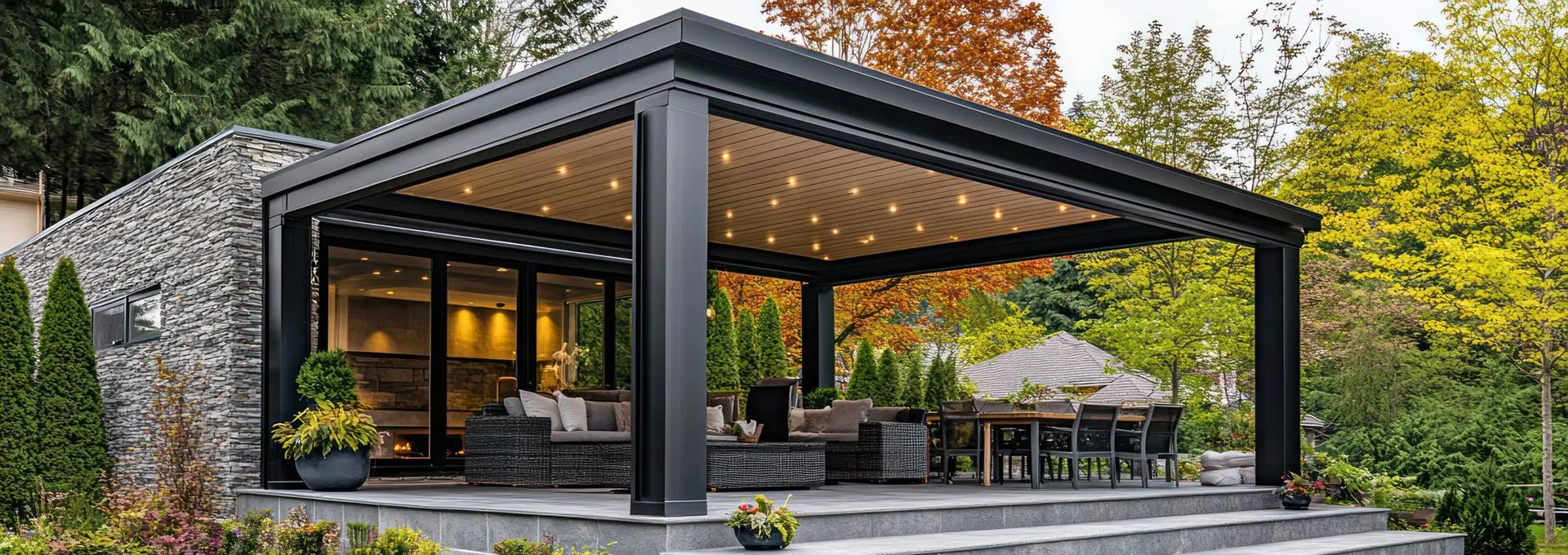
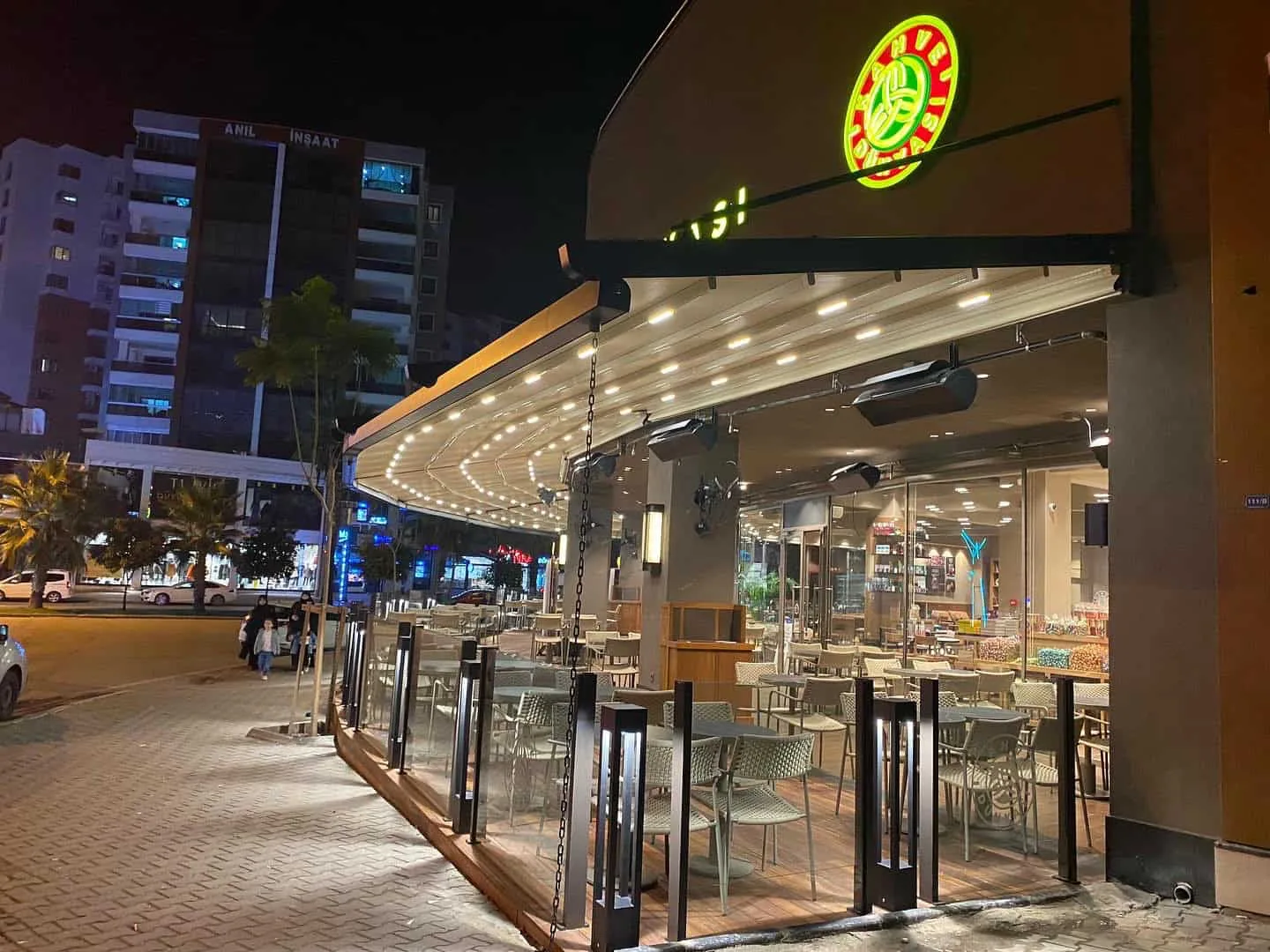
There are two basic ways to shade a space with fabric: hold the fabric without posts, or stretch it over a posted structure. The market calls these folding-arm awnings and pergola awnings, and compares them as though they were the same product.
The difference is not in the fabric but in the structure. That difference determines the achievable projection, the behaviour in wind, the performance in rain, and how much floor space you give up. This article compares them along exactly that axis.
Note: if what you want to compare is the type of canopy — fabric or louvres — that is a separate article: bioclimatic pergola or pergola awning.
Contents
- The core difference: posts or no posts
- What a folding-arm awning does
- What a pergola awning does
- Side by side
- Behaviour in wind and rain
- Five scenarios
- A third option: the double-opening awning
- Four common mistakes
The core difference: posts or no posts
In one sentence: a folding-arm awning holds the fabric in mid-air, a pergola awning stretches it over a frame.
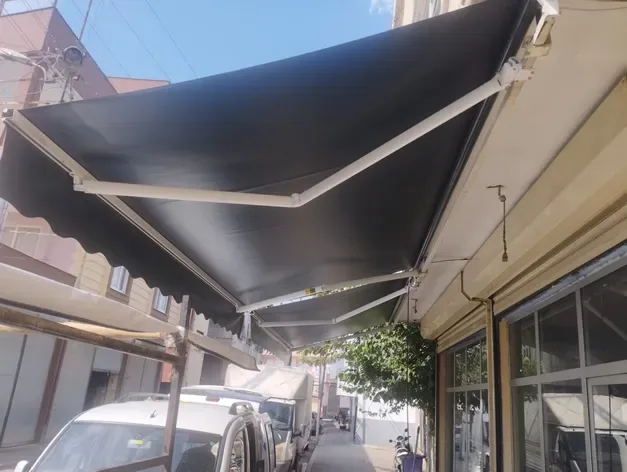
On a folding-arm awning the fabric extends on sprung arms from a cassette fixed to the wall. There is no post at the end of the arm; the fabric simply hangs in the air. That is why these are also called post-free awnings.
A pergola awning has a structure of aluminium posts and beams, and the fabric opens and closes along tracks on that frame. It leaves a footprint on the ground, and in exchange it carries far greater spans and far greater wind resistance.
What a folding-arm awning does
Its real strength is occupying nothing at ground level. Closed, it is a slim cassette on the wall; open, it covers the space beneath.
Where it leads:
- Balconies. Spaces built out to the balustrade with nowhere to put a post.
- Shopfronts. Posts on a pavement usually need a licence; a post-free system avoids the question.
- Terraces with a view. Nothing vertical stands in the sightline when it is open.
- Rented premises. Because it needs no work to the ground, it is far easier to remove and take with you.
Its limit follows from the same fact: only the arms carry the fabric. As the projection grows, so does the moment on the arm, which is why projection is limited on these systems and usually discussed in the 3.5–4 metre range. Details are on our folding-arm awnings page.
What a pergola awning does
Here the fabric is stretched over a frame of posts and beams. It opens and gathers along tracks, and the frame — not the fabric — does the carrying.
What that brings:
- Far greater spans. With posts sharing the load, arrangements of 6–8 metres and beyond are routine.
- Higher wind resistance. A rigid frame limits how much the fabric can move.
- Control of the pitch. The fall needed for drainage is fixed by the frame; on a folding-arm awning it depends on the angle of the arms.
- Side enclosures.Zip screens or glazing can attach to the same structure — a folding-arm awning has no structure to attach to.
- Lighting and heating. Recessed into the profile channels.
The price: a footprint on the ground and a higher budget. Details on our pergola awning systems page.
Side by side
| Criterion | Folding-arm awning | Pergola awning |
|---|---|---|
| Structure | Wall-fixed cassette and sprung arms | Aluminium post and beam frame |
| Ground footprint | None | Posts |
| Typical projection | Limited; usually discussed at 3.5–4 m | 6–8 m and beyond is routine |
| Wind | Must retract on a sensor | Higher resistance thanks to the frame |
| Rain | Sheds brief rain on pitch; must retract in heavy rain | Safer, with fixed pitch and a gutter arrangement |
| Side enclosures | Limited; needs its own structure | Attaches to the same frame |
| Installation | Short; no work to the ground | Requires foundations and fixings |
| Price band | Lower | Higher |
Behaviour in wind and rain
This is where the two genuinely diverge, and the subject most often glossed over in a sales conversation.
Wind
On a folding-arm awning the fabric behaves like a sail with a free edge. Once the wind threshold is passed, the system has to retract — that is not a fault but a design condition. A wind sensor is therefore not an option on these systems but, in practice, a requirement.
On a pergola awning the fabric sits within a rigid frame with its edges in tracks. Resistance is markedly higher, though not unlimited; ask for the manufacturer's figures.
Rain
Both systems shed water rather than holding it — provided the pitch is right. The difference lies in how that pitch is maintained:
- On a folding-arm awning the pitch comes from the arm angle, and fabric tension eases over time. In prolonged rain the risk of ponding in the middle rises, and the system should be retracted.
- On a pergola awning the pitch is fixed by the frame. Where a gutter is built into the front profile, water discharges in a controlled way.
In practice: if people will sit beneath it in rain, choose a pergola awning; if retracting the system and stepping inside is no hardship, a folding-arm awning is enough.
Five scenarios
1. Apartment balcony
Folding-arm. Nowhere to put a post, no appetite for work to the floor, and the projection is limited anyway.
2. Villa terrace used through winter
Pergola awning. The ability to add side enclosures, and a fixed pitch, are preconditions for four-season use.
3. Shop window
Folding-arm or a decorative awning. Posts on a pavement raise licensing and pedestrian safety questions of their own.
4. Café terrace with evening service
Pergola awning. Recessing lighting and heaters into the profiles removes visible cabling. We cover the operational planning in a separate guide.
5. Rented premises with a possible move
Folding-arm. Far easier to remove and relocate, and it leaves no trace on the ground.
A third option: the double-opening awning
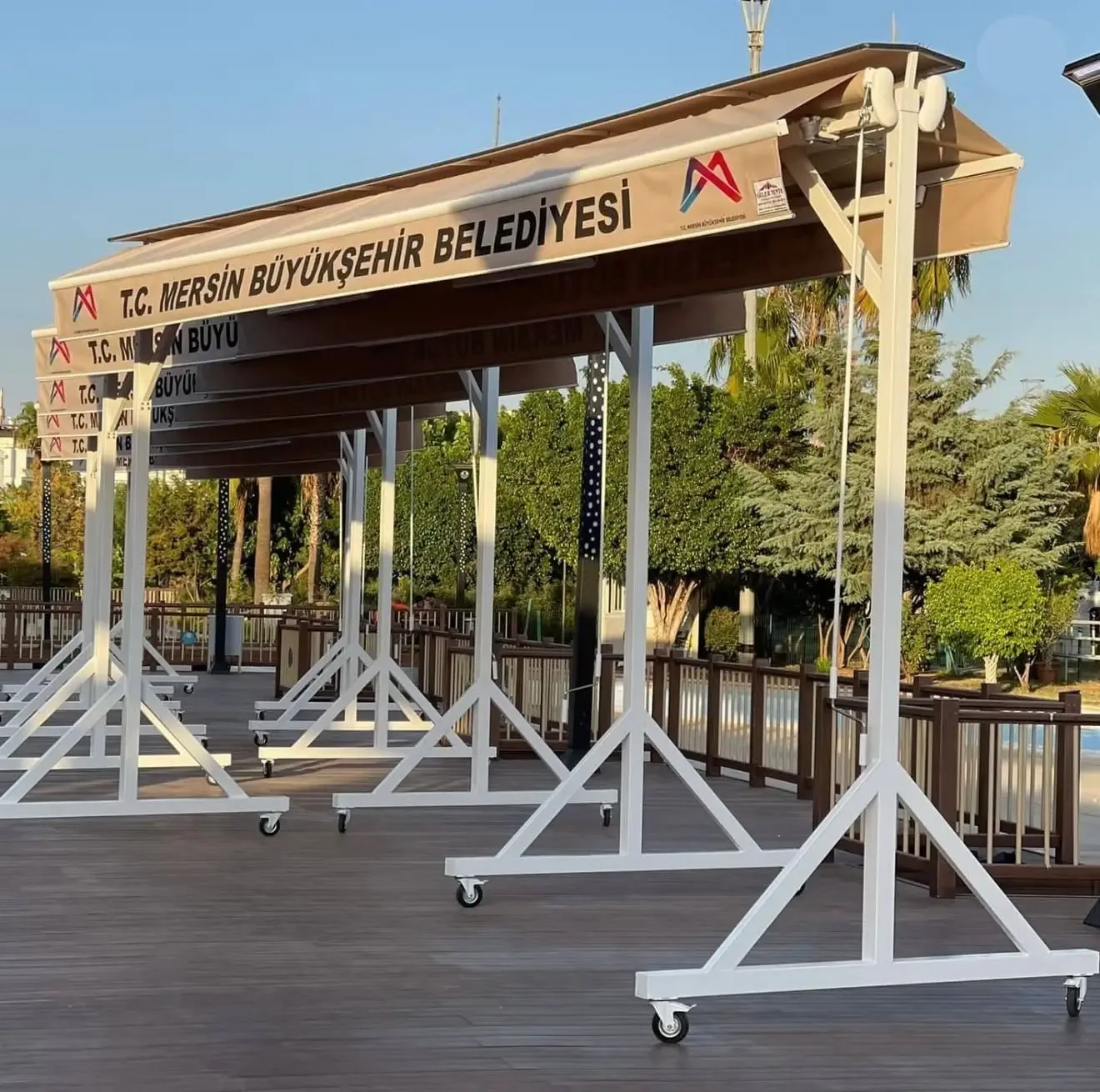
There is an arrangement that sits between the two. A double-opening awning extends the fabric in two directions from a central beam. Two posts under that beam are enough, so a wide area is covered with very few uprights.
It leads in open, unobstructed spaces: over car parks, open dining areas and event spaces. With fewer posts, table layouts are far easier to plan.
Four common mistakes
- Expecting pergola performance from a folding-arm awning. Without posts it has to retract in wind; that is not a defect.
- Skipping the wind sensor. On armed systems it is the cheapest insurance available and usually pays for itself in the first storm.
- Deferring side enclosures without thinking about structure. Adding zip screens to a folding-arm awning later means building a separate structure.
- Choosing the fabric independently of the system. Light fabric sags on a long-armed awning; we cover fabric selection in a separate article.
In short
Three questions settle it: Can you put posts on the ground? How much projection do you need? Will people sit beneath it in rain? No posts or a short projection points to a folding-arm awning; wide spans, side enclosures or four-season use point to a pergola awning. And if you want to cover an open area with as few posts as possible, put the double-opening arrangement on the table too.
Elit Pergola manufactures all three. Send us your dimensions, the condition of the ground and the hours you intend to use the space, and after a site visit we will explain which fits and why — get in touch here.