
Everyone planning a pergola meets the same fork in the road: aluminium or timber? Online, the answer is usually one-sided — because whoever wrote it sells one of the two.
This article compares them honestly. Why aluminium lasts longer in most situations, where timber is genuinely the better answer, and the subject that decides more of these choices than any other while getting discussed the least: the maintenance burden.
Contents
- The core difference: one is a material, the other a system
- Seven points of comparison
- Maintenance: what really decides it
- What climate changes
- Four situations where timber wins
- Does "wood-effect aluminium" actually work?
- Total cost over ten years
The core difference: one is a material, the other a system
There is an unfairness built into this comparison, and going on without saying so would mislead.
A timber pergola is usually a fixed structure: posts, beams and spaced battens overhead. The shade is fixed and nothing moves.
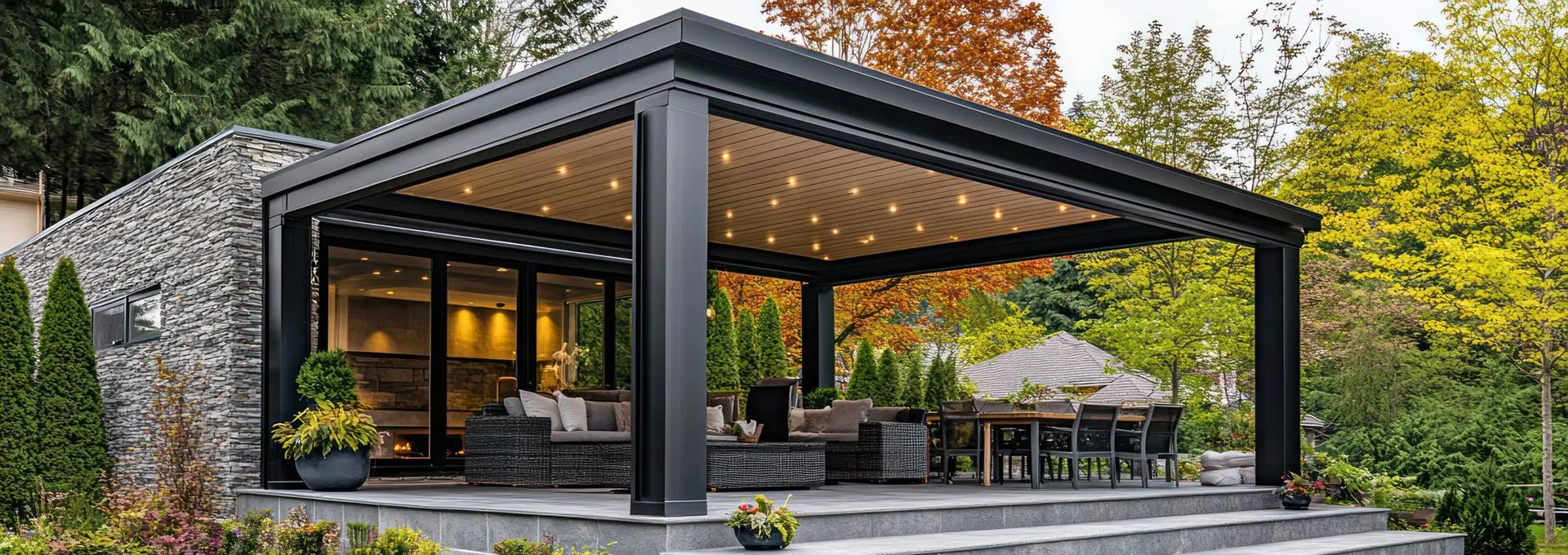
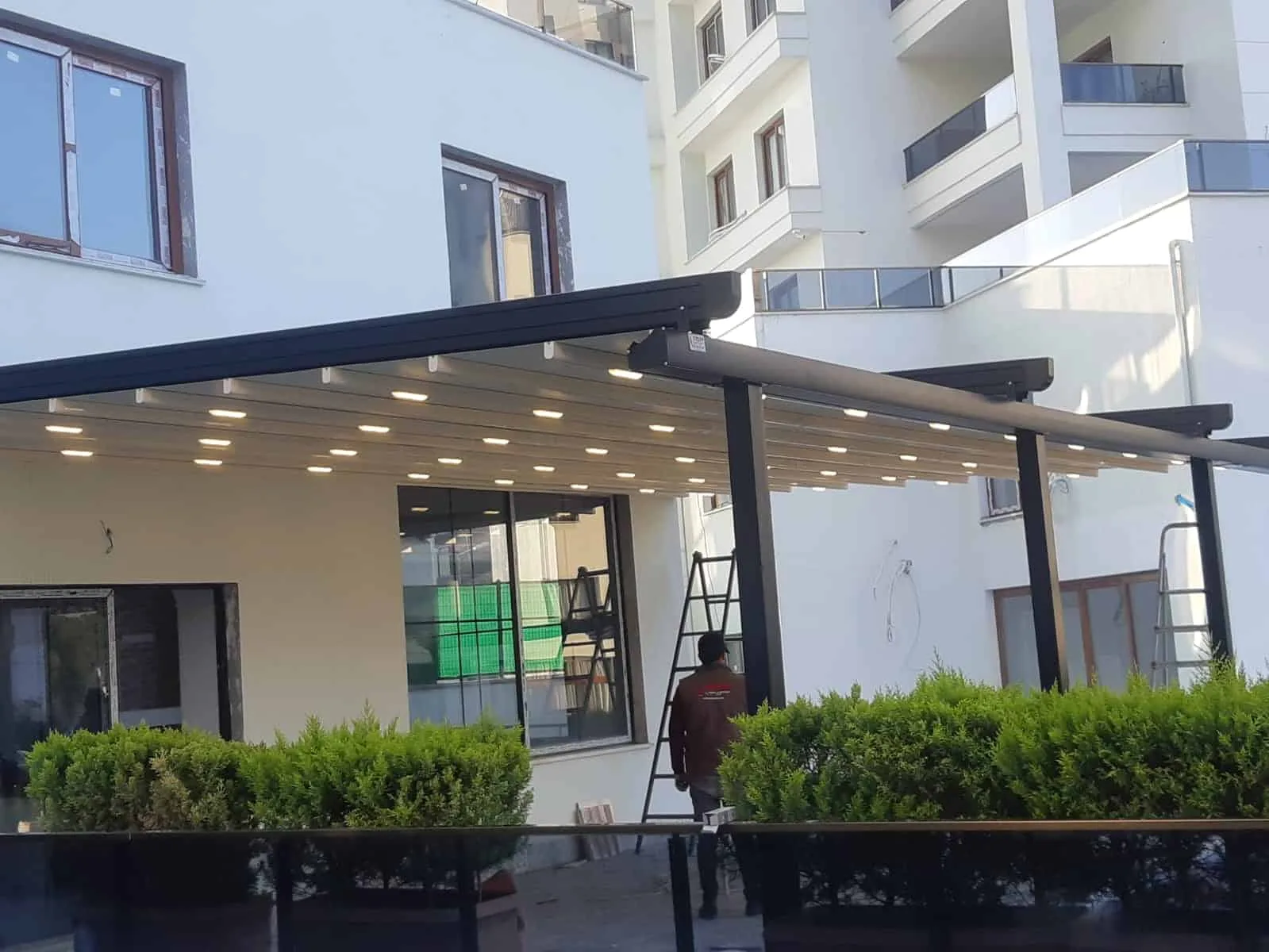
An aluminium pergola is usually a system: rotating louvres, a motor, concealed drainage, integrated lighting and side enclosures that can be added later. So the comparison is rarely between two materials — it is between a fixed structure and a moving system.
That distinction matters, because part of the price gap comes from function, not material. Fixed aluminium pergolas exist too, and they sit in a different band.
Seven points of comparison
| Criterion | Aluminium | Timber |
|---|---|---|
| Service life | Commonly quoted at 20 years and beyond; will not rust and is unaffected by damp | Commonly quoted at 10–15 years with regular care; considerably less if neglected |
| Maintenance | An annual clean; the finish is not renewed | Sanding and re-treating or re-varnishing every one to three years |
| Span capacity | Longer spans at the same section; structural calculation is routine | Sections grow quickly over long spans and the structure gets heavy |
| Moving canopy | Louvres, fabric or sliding panels can be integrated | Generally fixed; a moving system needs its own structure |
| Drainage | A concealed gutter inside the profile is possible | Needs an external gutter; contact with water shortens the life of the timber |
| Lighting and services | Recessed into the profile channel, cabling hidden | Surface-run or routed into a channel |
| Appearance | Crisp and contemporary; wood-effect finishes available | Natural and warm; the colour shifts over time |
Maintenance: what really decides it
Comparisons usually say "timber needs maintenance" and stop there. Nobody can decide anything from that sentence until it is unpacked.
A typical cycle on a timber pergola:
- Clean and brush down the surfaces.
- Sand any lifted or cracked areas.
- Apply preservative or exterior varnish — usually two coats.
- Check metal fixings for corrosion.
- Check moisture near ground level; timber rots from the soil upwards.
In the early years, every three years may be enough. As the structure ages, the interval shortens — faster still on south-facing surfaces in direct sun.
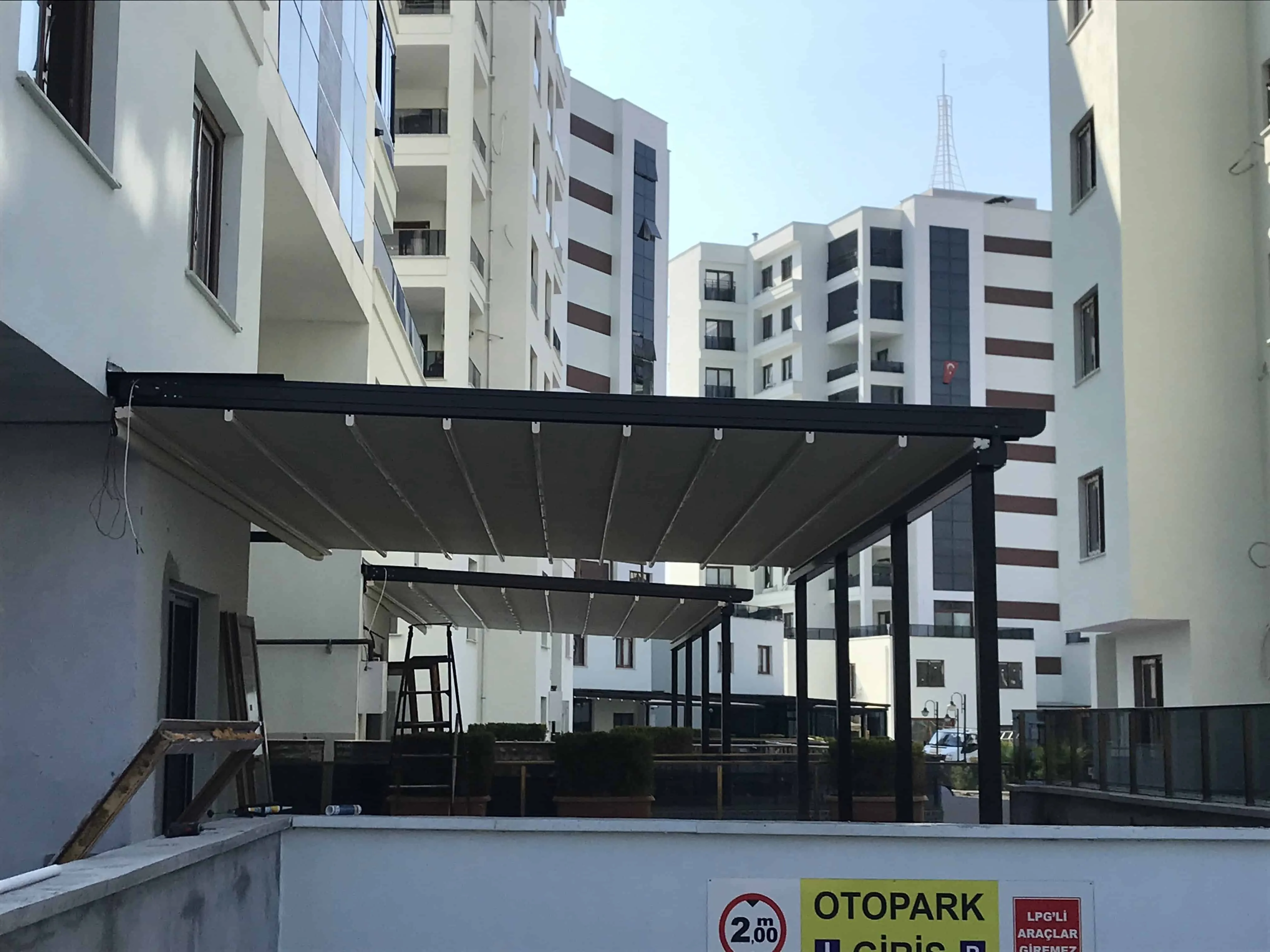
The cycle for aluminium is far shorter: an annual clean with warm water and a soft cloth, plus gutter and rail checks where the system moves. A powder-coated finish is not renewed — but that depends on the quality of the coating. A thin coating dulls within a few years, which is why the micron value belongs in the quotation.
We cover how finish and coating affect price in our guide to reading a quotation.
What climate changes
The material decision is not the same everywhere. Three climate factors shift the table noticeably:
- Coastal and salt-laden air. Aluminium does not rust, but the finish classification matters in salt air — ask about anodising or a higher-durability coating. For timber, salt-laden damp shortens the maintenance interval.
- High humidity and shade. In a north-facing garden with little sun, timber dries slowly and the risk of fungus and algae rises. Aluminium has the advantage here.
- Harsh sun. Mediterranean sun fades timber within a few seasons and cracks the varnish. On aluminium, only the gloss level is affected, and on a good coating that happens far more slowly.
In Adana and the surrounding provinces — long, very sunny summers, rainfall concentrated in winter and humid air — aluminium pulls clearly ahead on maintenance.
Four situations where timber wins
The table above leans towards aluminium, but there are situations where timber genuinely is the better answer, and it would be dishonest not to say so:
- When the landscape itself is timber. In a garden built around timber decking, timber fencing and timber furniture, an aluminium mass can read as foreign.
- When planting will grow over it. For vines, honeysuckle or climbers, timber battens make a natural support — and the regulation's definition of a pergola refers to exactly this use.
- When a small fixed canopy is enough. For a 2×3 metre seating corner, a moving system may be unnecessary; timber is both cheaper and sufficient.
- In conservation areas. Material and colour may be conditioned in protected settings, and some areas require timber.
Does "wood-effect aluminium" actually work?
It does, and the choice has grown noticeably in recent years. A wood grain is transferred onto the aluminium surface by a sublimation process.
It helps to set expectations correctly:
- It is hard to tell apart at a distance; up close, touch gives it away as metal.
- The grain repeats. It lacks the randomness of real timber, and the repeat can be visible on long profiles.
- The maintenance advantage survives. The finish does not change how aluminium behaves.
For people whose garden is built around timber but who do not want the upkeep, this middle path is often the right answer. See the options on our products page.
Total cost over ten years
A first price comparison usually favours timber. Over ten years the picture changes, because two more items enter the calculation:
- Maintenance labour and materials. Re-treating every three years means three rounds in a decade. The materials are cheap; the labour is not.
- Component replacement. Post bases near the ground and battens taking direct rain are the first parts to tire.
Against that, the expected spend on aluminium over the same decade is limited: cleaning, plus servicing the motor and mechanism where the system moves. So the question to ask is not "which is cheaper today" but "how many times do I want to deal with this structure over the next ten years".
In short
If you want a moving canopy, concealed drainage, integrated lighting or a wide span, the decision is already aluminium — timber was never designed to carry those functions. If you are planning a small fixed canopy for climbing plants in a garden built of timber, timber remains a right and beautiful answer.
Elit Pergola manufactures in aluminium: see our bioclimatic pergola page for louvred solutions and pergola awning systems for fabric ones. Send us your dimensions and a sense of your garden and get in touch — we will talk through which arrangement fits and why.