

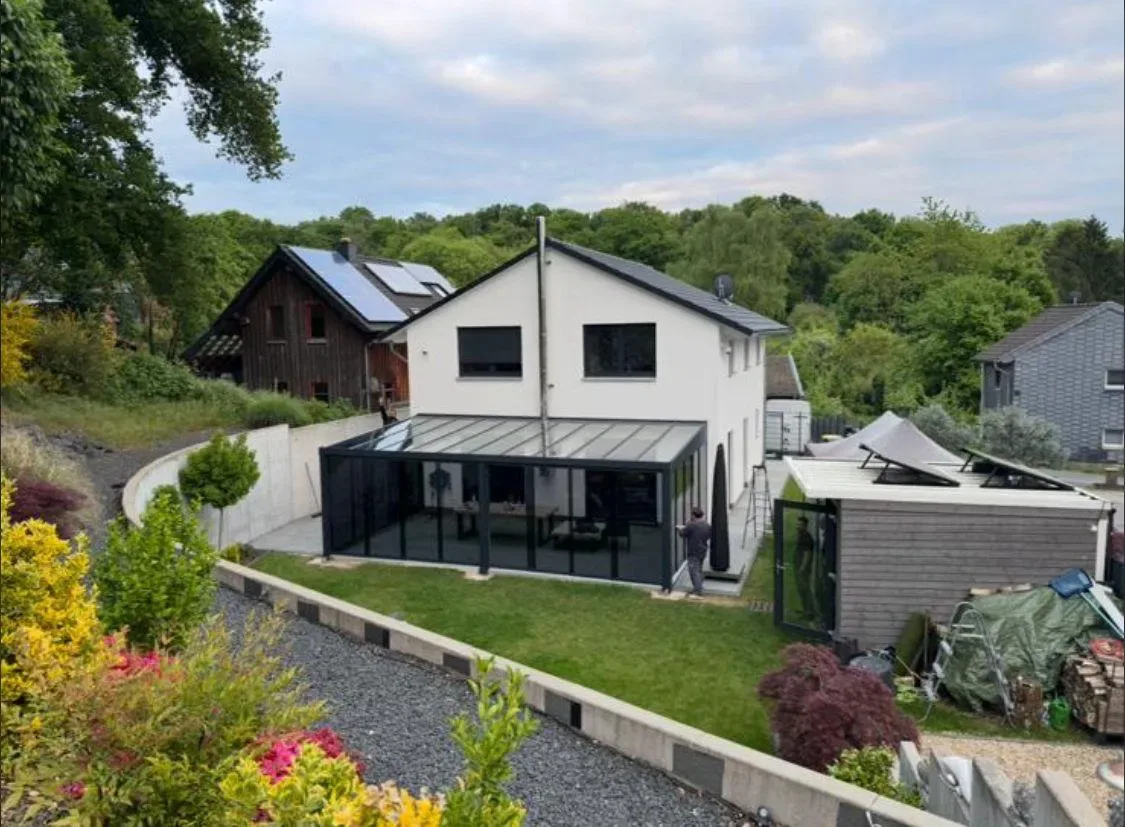
Most complaints about winter gardens open with the same sentence: "It looks wonderful, but the glass mists up constantly." Mould in the corners follows, then swollen timber and staining on metal surfaces.
This is not a product fault. Condensation is physics, and where it is not allowed for at design stage it is inevitable. The good news: it is preventable, usually through decisions that are not expensive.
This article explains why it happens, which five decisions determine the outcome, and what to ask before you commission the work.
Contents
- Why does glass mist up?
- Where it starts: thermal bridges
- The five decisions that decide the outcome
- Ventilation: the cheapest fix
- Heating: type and position
- Plants and the moisture load
- A checklist before you commission
Why does glass mist up?
Air holds a certain amount of moisture depending on its temperature: warm air more, cold air less. When warm, humid air meets a cold surface it drops below what it can carry and leaves the surplus on the surface as water. That temperature is the dew point.
A winter garden is practically a laboratory for the effect:
- Inside there are moisture sources — people, plants, kitchen steam through an open door.
- Outside there is cold, and the only thing between the two is a pane of glass.
- Glass is the coldest surface in the house, and condensation always starts on the coldest surface.
So the question is not "will there be condensation" but "how warm can we keep the coldest surface, and how do we get the moisture out".
Where it starts: thermal bridges
Misting usually begins at the coldest point, and in practice those points are predictable:
- The aluminium profile. Aluminium conducts heat extremely well. A profile without a polyamide thermal break stays colder than the glass itself, so that is where misting starts.
- The glass edge and spacer bar. The metal spacer at the edge of a double-glazed unit is a classic weak point; warm-edge spacers close most of that gap.
- The floor junction. Where the bottom profile sits in direct contact with the outside, a cold bridge forms.
- The roof-to-wall junction. The detail where the canopy meets the building wall is where insulation continuity breaks most often.
Note: misting between the two panes of a sealed unit is not condensation — the unit has failed and must be replaced.
The five decisions that decide the outcome
1. The glass unit
In a heated space, single glazing practically guarantees condensation. Double glazing lifts the internal surface temperature well above the dew point, and a low-emissivity coating strengthens the effect.
2. Profile insulation
Fitting double glazing into an unbroken profile is like putting on a winter coat and leaving the hood down. The thermal bridge continues through the frame, and misting persists along the profile edge.
3. A route for the moisture
Moisture needs somewhere to go. In a completely sealed volume it simply accumulates; ventilation complements insulation rather than replacing it.
4. Heating type and position
Where the heat source sits matters more than its output. A source directed at the glass raises the surface temperature and reduces condensation directly.
5. Managing moisture sources
A dozen pot plants, drying laundry or an open route to the kitchen multiply the moisture load. The way the space will actually be used must be settled before the design is.
Ventilation: the cheapest fix
Condensation makes everyone think about glass first, but the cheapest and most effective intervention is ventilation. It comes in three levels:
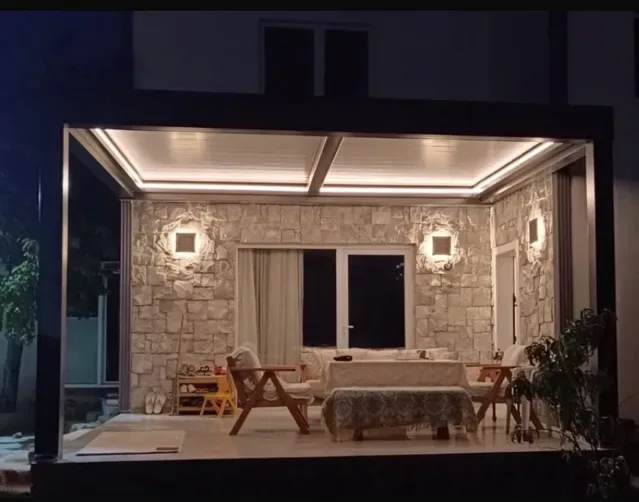
- Natural ventilation. Two opposing openings — low in, high out. Warm humid air rises and leaves through the top. With a louvred canopy, cracking the louvres open does exactly this; it is one of the lesser-known benefits of a bioclimatic pergola.
- Controlled ventilation. A small humidity-sensing fan or an automatic roof vent that opens once a threshold is crossed.
- A dehumidifier. Worth considering where planting is dense or the space opens onto a pool — alongside ventilation, never instead of it.
A practical rule: ventilate at least twice a day, briefly, with openings on opposite sides. Opening wide for a short time loses far less heat than leaving a window ajar all day.
Heating: type and position
The most common mistake is positioning the heater around the seating. The right approach is to give the heat to the cold surface:
- In front of the glass. A radiator or convector placed along the glazed elevation creates a rising curtain of warm air at the surface and cuts condensation directly.
- Underfloor heating. Heats the surface evenly and moves little air, so it does not lift dust. On a new floor, this is the cleanest solution.
- Infrared heaters. They warm objects rather than air, giving quick comfort but not raising the glass surface temperature — on their own they do not solve condensation.
Which of the three suits depends on the arrangement outside. Where the space is only partly enclosed — with zip screens, for instance — infrared is usually the better answer; in a fully enclosed volume, heating along the glass takes priority.
Plants and the moisture load
A winter garden is named after its planting, and planting is also what upsets the moisture balance most. A medium pot plant releases hundreds of millilitres of water into the air each day through transpiration. Ten pots amount to a noticeable load in a small room.
- Water less often in winter; do not let the soil surface stay permanently wet.
- Keep pots away from the glass — moisture gathers at the foot of the coldest surface.
- If you are planning a lot of planting, step the ventilation up a level from the outset.
A checklist before you commission
- Is the glazing double, and does it carry a low-E coating? Is it stated in the quotation?
- Is the profile thermally broken with a polyamide bar?
- Is the spacer bar a warm-edge type?
- Are there at least two opposing ventilation openings, one low and one high?
- If the canopy is louvred, can the ventilation position be adjusted?
- Will the heating sit along the glazed elevation?
- Does insulation continuity break at the floor junction?
- Has the roof-to-wall junction been drawn?
- How many plants, how many people, and how often is the space to be used?
- If condensation does occur, is there a channel to collect it?
In short
Condensation is not the fate of a winter garden; it is the result of the balance between insulation and ventilation. Glazing and profiles raise the surface temperature, ventilation carries moisture away, and the position of the heating supports both. Leave one of the three out and the glass mists up.
At Elit Pergola we discuss all three at the site visit, before any system is chosen. Look through the retractable roof, guillotine glass and sliding glass options, then get in touch. We compare which glazing suits which space in a separate article.