
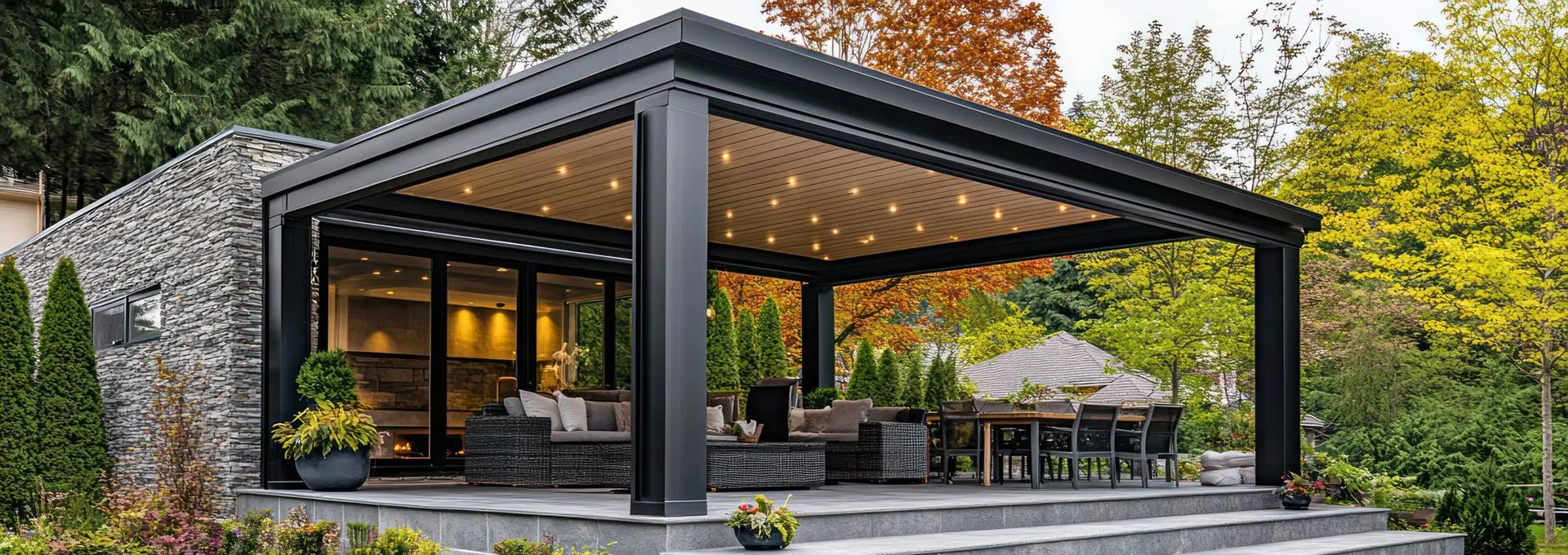
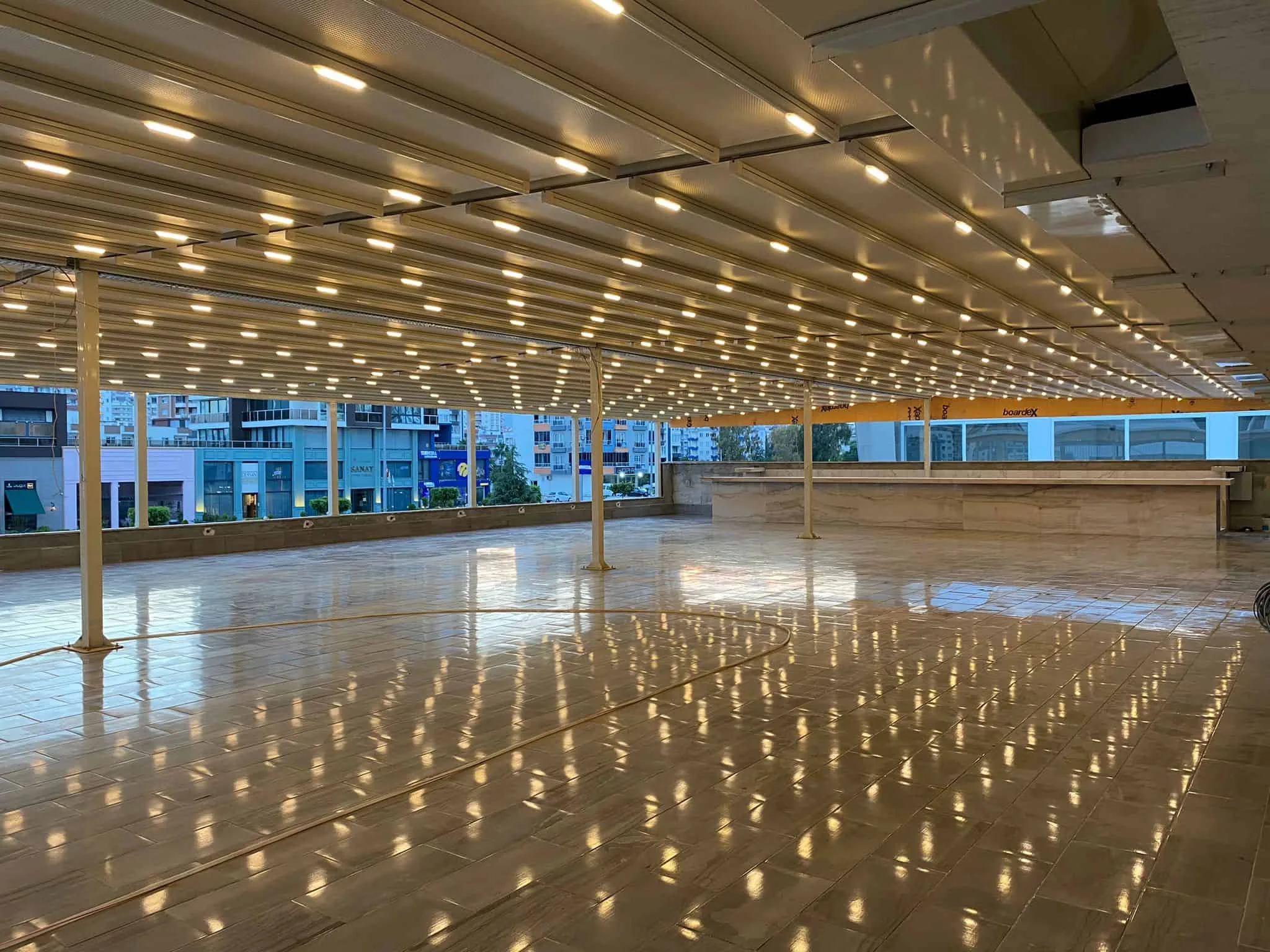
The term "rolling roof" has been stretched so far in recent years that three different systems now share the name. Sometimes it means sliding glass panels, sometimes a fabric canopy on rails, and sometimes a louvred pergola is sold under the same heading.
This article settles the term: what a rolling roof actually does, where it parts company with a louvred pergola, and which behaves better in which space. We have included the differences in drainage, snow loading and motors — that is usually where the decision is made.
Contents
- What a rolling roof is
- How it differs from a louvred pergola
- Side by side
- Drainage and snow loading
- Which space suits which system?
- Motors, spans and maintenance
- Five questions to ask when quoting
What a rolling roof is
A rolling roof is a retractable canopy whose covering slides to one side and stacks there. The covering — glass, polycarbonate panels or technical fabric — travels on rails: closed, it gives a continuous ceiling; open, an entirely clear sky.
The logic is in the name: the covering does not rotate, it rolls. That single-sentence difference determines everything else about the system.
These systems are normally motorised and operate at the touch of a button. In commercial settings they are commonly tied into automation and closed automatically by a rain sensor.
How it differs from a louvred pergola
The confusion comes from both being sold as "retractable roofs". Their movement is fundamentally different.
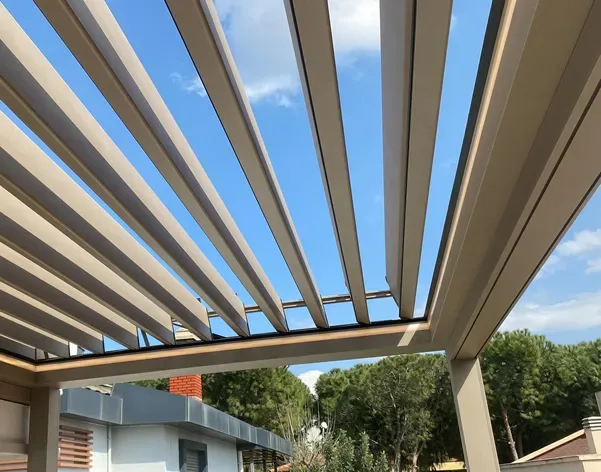
On a louvred, bioclimatic pergola aluminium blades rotate on their own axis. With the louvres open, the profiles stay where they are — the sky reads as striped. In between, the depth of shade adjusts in stages and warm air escapes through the gaps.
On a rolling roof the covering slides away and stacks at one end. There is no intermediate position: the system is either closed or open. In exchange, when it opens the aperture clears completely; on a louvred system the profiles never disappear.
Side by side
| Criterion | Rolling roof | Louvred pergola |
|---|---|---|
| Movement | Covering slides and stacks | Louvres rotate on their axis |
| Intermediate positions | None — open or closed | Yes — shade adjusts in stages |
| Sky when open | Completely clear | Profiles remain in place |
| Ventilation | Full when open; none when closed | Continues through the louvre gaps even near the closed position |
| Appearance when closed | Continuous ceiling surface | Louvre lines visible |
| Noise in rain | Depends on the panel; pronounced with glass and polycarbonate | Duller on aluminium louvres, less resonant |
| Wide spans | Limited by rail length; intermediate support may be needed | Limited by louvre length; modular bays are common |
Drainage and snow loading
These two subjects separate the systems most clearly and get discussed least in quotations.
Drainage
Closed, a rolling roof forms a pitched surface; water runs down it into a side gutter. The critical point is weatherproofing at the rails: the channel the covering runs in is also where water must not pass. A poorly resolved rail junction shows up as drips in the first long downpour.
On a louvred system, water runs off closed louvres into a concealed gutter in the structural profile and down through the posts. The detail differs, but the question is the same: ask in writing where the water goes.
Snow loading
In Adana and along the Mediterranean coast, snow does not drive the decision. In central and eastern Anatolia and at altitude, it does:
- Where snow must be carried, the covering type and structural sections are selected accordingly.
- Fabric-covered rolling roofs are not designed for snow loading and must be retracted before winter.
- For glass and panel systems, ask for the load capacity in writing.
Which space suits which system?
Where a rolling roof leads
- Event and large commercial spaces. Clearing the aperture completely makes a busy room feel markedly more open.
- Winter garden arrangements. A continuous ceiling when closed makes a heated volume easier to seal than a louvred canopy does.
- Places where the sky is the view. Terraces that look upwards, or a canopy over a pool.
Where a louvred pergola leads
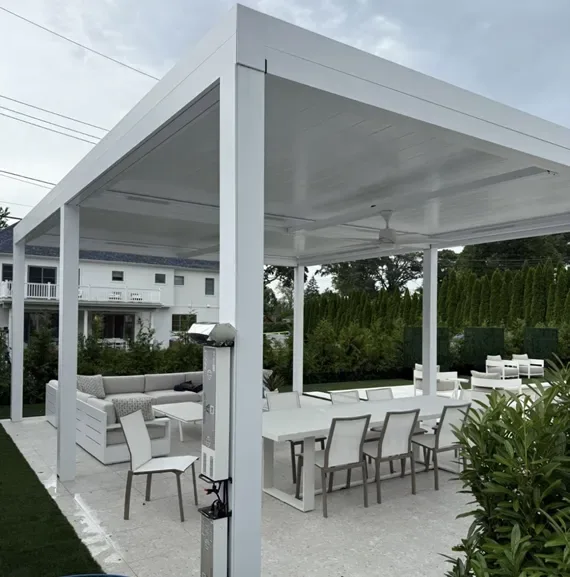
- Daytime use in a hot climate. Stepped shade control and continuous ventilation make a tangible difference through a Mediterranean summer.
- Frequent but brief rain. Closing the louvres takes seconds, and so does returning to an intermediate setting.
- Domestic terraces. The system is more widespread, the service network is broader, and the price band is usually more flexible.
Plenty of projects use both: a louvred canopy over the main seating and a rolling roof at the entrance or over the pool. The decision is made space by space. We set out the louvred side on our bioclimatic pergola page and the rolling roof side on our retractable roof systems page.
Motors, spans and maintenance
The moving mass on a rolling roof is greater than on a louvred system, which makes motor and rail selection more critical.
- Wider spans strain the rails. Twin motors or an intermediate support are standard on wide bays; if a quotation shows a single motor, ask why.
- Rail cleaning is the heart of maintenance. Leaves, dust and grit in the rail make the system labour and shorten motor life.
- A rain sensor is essential in commercial use. A system left open can ruin furniture in a single shower.
- Plan for power cuts. Whether the system can be closed manually is a specification decision, not an afterthought.
Five questions to ask when quoting
- What is the covering? Glass, polycarbonate or fabric — three different weights, sound levels and snow behaviours.
- Where does water not pass through the rail? The seal detail at the rail-to-covering junction should be explained.
- How many motors, over what span? Put the number and the reasoning in writing.
- What is the snow load capacity? If your region sees snow, ask for the figure in writing.
- Will side enclosures be added later? If zip screens or glazing are planned, the structure has to allow for them now.
In short
The difference comes down to one sentence: one slides the covering, the other rotates the louvres. If a completely clear sky matters to you and the space will be used as an enclosed volume in winter, a rolling roof leads. If you want stepped shade control and ventilation even near the closed position, the louvred system is the right side of the line.
Elit Pergola manufactures and installs both. Send us the dimensions, orientation and intended use, and after a site visit we will set out which is the better fit and why — reach us through our contact page. If you are curious about what drives the price, see our guide to reading a quotation.